
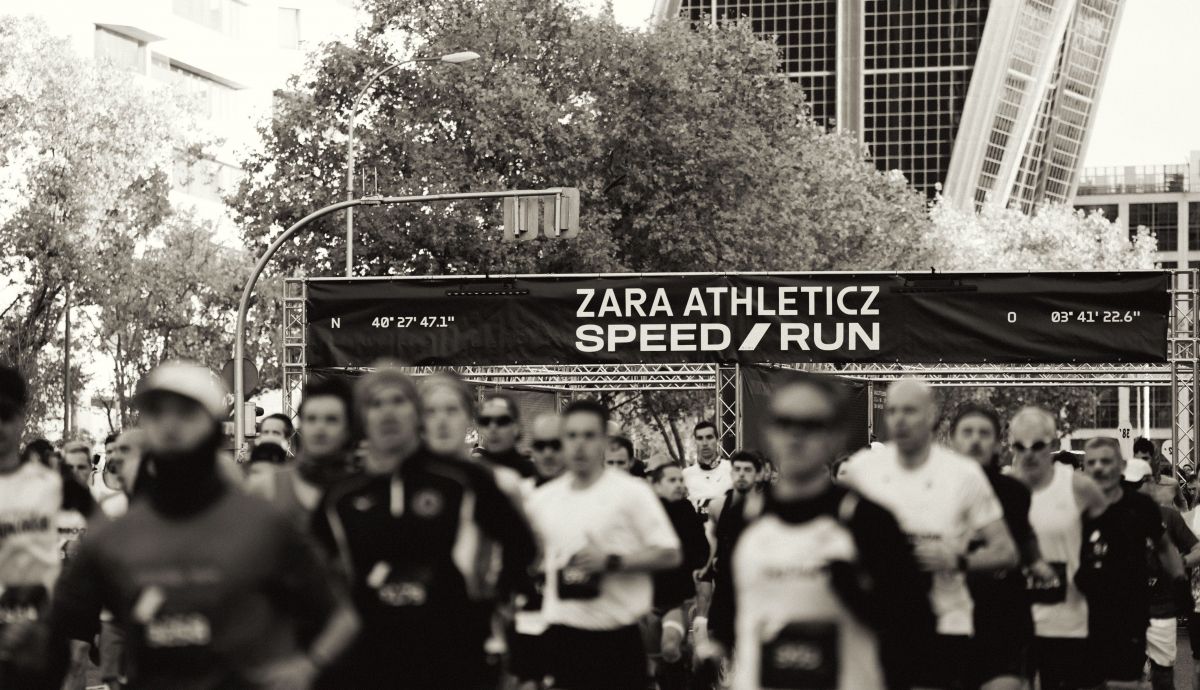
The Zara Athleticz Speed Run 2026 debuts a course that invites fast running, but forces you to choose carefully where to press. The first kilometer maintains the pace along Castellana and the descent along Padre Damián. After that, Madrid’s broad central avenues allow you to stabilize the rhythm up to Atocha, where the most favorable stretch of the 10K begins. The final straight, already heading toward the finish on Paseo de las Yeserías, alters the script with a slight uphill false-flat. More than 12,000 runners will tackle this Sunday the new route, with four wave starts between 9:00 and 9:15. The race has already produced two of the most striking performances in Spanish road racing. Adel Mechaal ran 26:46 in 2024 and Laura Luengo 30:59 in 2025. With fewer turns and two kilometers of downhill more pronounced in the second half, those marks set the benchmark for an edition in which many recreational runners will also be looking to improve their times.
Kilómetro 1. De Plaza de Castilla a Padre Damián
The race repeats last year’s start, just after the Plaza de Castilla tunnel, thereby avoiding the uphill that would have to be tackled from the inside. The first 400 meters run along Paseo de la Castellana. The peloton then turns toward Alberto Alcocer and links with Padre Damián via one of the few 90-degree bends on the course. There comes the first rapid descent. RUNNER TIP: let the slope help you gain speed and try to exit the turn without an acceleration. Between the start, the pack, and the descent, it’s easy to pass the first kilometer much faster than planned. Save that margin for the end.
Del Bernabéu a Atocha, el tramo para fijar el ritmo
After passing by the Bernabéu, the course enters its most regular stretch, with a descent around 1%. It is the most recognizable part of the 10K, passing Colón, Cibeles, Neptuno, and the Prado promenade before reaching Atocha. The wide avenues allow you to find a group running at your pace and to overtake without chaining speed changes. RUNNER TIP: use this segment to settle into the target pace. If the group you’re with speeds up, let them go and maintain an effort you can sustain until Atocha. The steeper downhill and the final straight still lie ahead.
Del kilómetro 6,5 al 8,5, la gran bajada hacia Matadero
After the false flat at Plaza del Emperador Carlos V, near Atocha station, begins the main novelty of the course. Avenida de Santa María de la Cabeza and Embajadores Street connect two kilometers with an average downward slope of 3%. It is the fastest stretch of the 10K and takes runners toward the Matadero area and Legazpi square. RUNNER TIP: take advantage of the downhill to run faster at a similar effort. Let the pace open up naturally and avoid forcing it. If you reach Legazpi with room to increase the effort, you can capitalize on it when the gradient changes.
Desde Legazpi, un último kilómetro que pica hacia arriba
In Legazpi Square comes the only turn that exceeds 90 degrees. From there there remains roughly one kilometer in a straight line to the finish on Paseo de las Yeserías. The ascending slope, just under 1%, seems modest on paper, but it’s noticeable in the legs after two downhill kilometers. RUNNER TIP: as you exit Legazpi, set the effort as a reference and accept that your pace may drop a few seconds when the gradient changes. Increase the intensity progressively and, with 300 or 400 meters to go, push hard to the finish.
