
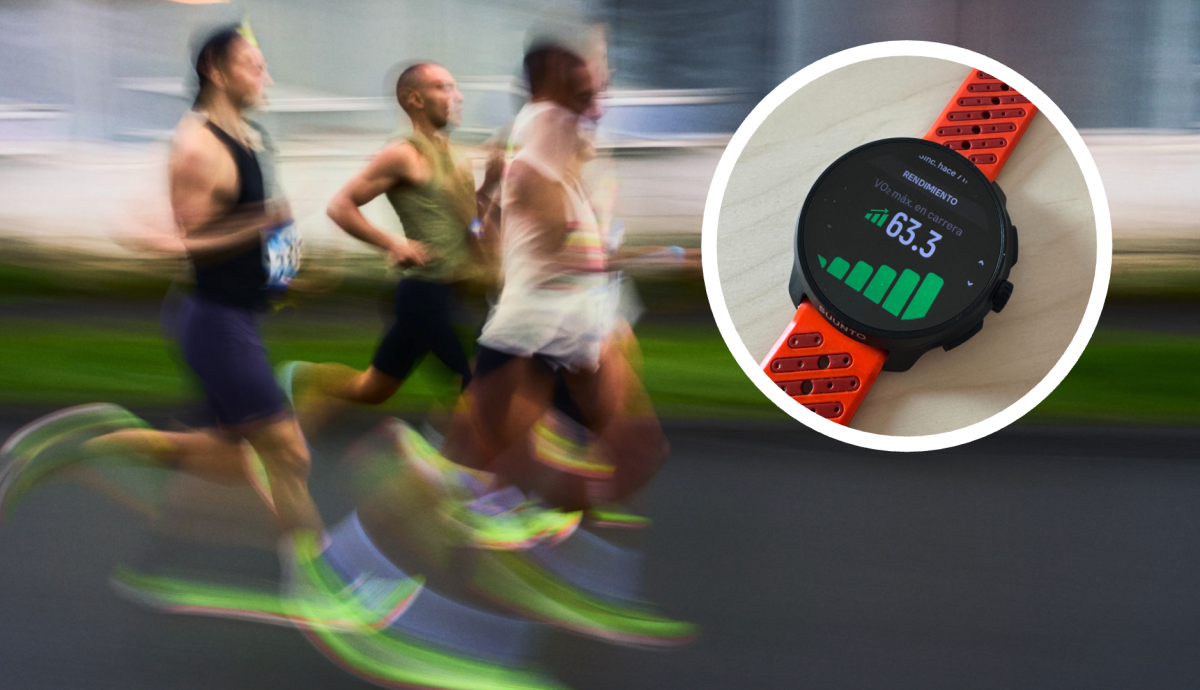
Whether you train, run, ride a bike, or simply want to know how your body responds to effort, understanding what VO₂ max really means can help you train better… and stop worrying about a number that, by itself, doesn’t tell the whole story.
What exactly is VO₂ max?
VO₂ max is the maximum amount of oxygen our body can capture, transport, and use during high‑intensity exercise. It is considered one of the best indicators of aerobic capacity.
When we exercise, we breathe in oxygen, which travels in the blood and is carried to the muscles. There, it participates in the processes that allow energy to be produced to sustain physical activity. The greater the body’s capacity to use oxygen, the greater, in principle, our ability to sustain intense aerobic efforts. It is expressed in milliliters of oxygen per kilogram of body weight per minute (ml/kg/min). Therefore, in general terms, a high VO₂ max is associated with good cardiorespiratory fitness. But there is an important word: “generally”.
Because having a high VO₂ max does not guarantee that you are the best runner, cyclist, or athlete. Performance also depends on factors such as movement economy, lactate threshold, strength, technique, experience, and the ability to maintain a certain percentage of VO₂ max for a long time.
So, what VO₂ max is good?
Here begins the problem with the charts. VO₂ max depends on age, sex, training level, body mass, body composition, and other factors. Therefore, it doesn’t make much sense to claim there is a single figure that separates a “good” VO₂ max from a “bad” one.
As a very general reference, in adults values are roughly between 30 and 60 ml/kg/min, though there is huge individual variability. In trained athletes, values can be considerably higher.
In recreational athletes, for instance, the reference text usually places trained men around 50-60 ml/kg/min and trained women around 45-55 ml/kg/min, while high-level athletes can exceed these figures widely.
But be careful: a 50 does not mean the same at 25 as at 55 years old, nor does it have the same meaning in an athlete as in a sedentary person. The most useful comparison, therefore, is with yourself.
VO₂ max is not a genetic decree
There is a widely held idea: “my VO₂ max is low because genetically I’m not built to run.” The reality is rather more interesting. Training can substantially improve VO₂ max, but not everyone responds to the same program in the same way. The HERITAGE study found enormous variability in the response to endurance training: after a 20-week program some people improved barely, while others experienced very large increases. The authors also estimated a substantial genetic contribution to that variability.
What does this mean for you?
That if after a few weeks of training your VO₂ max does not rise as fast as you expected, you are not necessarily doing something wrong. You may need to change the type of stimulus, review the training load, or simply give the process more time.
And there’s another good news: you can improve aerobic capacity at virtually any age, though the rate of adaptation changes with age.
Can I trust the VO₂ max on my watch?
Yes… but with caveats. This is probably the most important part for anyone training with a Garmin, Apple Watch, Polar, Suunto, or any other sports device. The true VO₂ max is determined by a laboratory gas-analysis test. The athlete performs progressive exercise—usually running on a treadmill or cycling—while breathing through a mask that allows analysis of oxygen consumption and other parameters.
By contrast, the watch does not measure directly the oxygen you are using. It makes an estimate from variables such as heart rate, pace, movement, and other data. So you shouldn’t interpret that a value of 51 automatically means your laboratory VO₂ max is exactly 51. Wrist-worn estimates can show appreciable errors compared with laboratory measurement.
View this post on Instagram
The key: look at the trend, not the isolated number
If your watch reads 47 today and 49 in two months, that can be an interesting signal, especially if the measurements were taken under similar conditions. But if one day you go from 48 to 51 and the next week you’re back at 48, it doesn’t mean you’ve gained and then lost three points of aerobic capacity. Temperature, fatigue, sleep, hydration, terrain, pace, heart rate, and even training characteristics can influence the estimate.
Use your watch’s VO₂ max as a trend indicator, not as a medical-grade precision test.
How is it really measured?
The most accurate method is a graded exercise test with direct gas analysis. It usually starts with a few minutes of light exercise and progressively increases speed, resistance, or incline until reaching maximum intensity. During the test, variables such as oxygen consumption, heart rate, and speed or power are recorded.
Besides knowing your VO₂ max, a laboratory test can provide very interesting information to structure training, such as maximum heart rate and different training zones.
There are also field tests that allow estimating VO₂ max, such as the 12-minute Cooper test. They are much more accessible options, though less precise than direct gas analysis.
The best way to raise your VO₂ max
Here comes the practical part. To stimulate VO₂ max you need to include high-intensity sessions, in which you spend a sufficient amount of time close to your maximum aerobic capacity. It doesn’t mean you have to train at the limit all the time. In fact, doing so would be a fairly quick recipe for accumulating fatigue.
The most effective strategy is to combine intense work with enough low- and moderate-intensity aerobic training and proper recovery.
Training 1: 3-minute intervals
A classic session can be:
Warm-up: 10 minutes of easy running.
Main part:
4 × 3 minutes at an intensity near VO₂ max, with 3 minutes of easy jogging recovery between repeats.
Cool-down: 10 minutes of easy pacing.
HIIT intervals can sit roughly between 3 and 5 minutes, depending on the athlete’s level and the session’s goal.
The effort should feel demanding. It’s not about a 30-second sprint, but about sustaining a high effort for several minutes.
Training 2: 1-kilometer repeats
For runners who prefer to work by distance:
10 minutes of warm-up + 4 × 1 km at VO₂ max intensity, with 3-4 minutes of easy recovery + 10 minutes of cool-down.
The exact pace will depend on your level. The important part is that the repetitions are sufficiently intense to accumulate time near your maximal aerobic capacity, but without turning the session into a race.
Training 3: play with hills
Hills are another fantastic tool.
Look for a slope around 3-5%, sufficiently steep to increase the demand but still allow reasonable running technique.
After warming up, you can do:
6-7 × 3 minutes uphill, at a high intensity, recovering on the downhill.
The incline adds resistance and allows reaching a high cardiovascular intensity without needing to run at extremely high speeds.
Not everything is VO₂ max. And this is perhaps the most important conclusion. VO₂ max is a superb piece of the puzzle, but it is not the whole puzzle. You can have an excellent VO₂ max and not run a marathon particularly fast. And you can have a more modest value and achieve extraordinary performance thanks to good running economy, an excellent lactate threshold, a great endurance capacity, and years of training.
That’s why, if your goal is to run faster, you shouldn’t limit yourself to watching how your watch’s number evolves.
Also note:
The true objective: having a big engine… and knowing how to use it
A high VO₂ max means you have a strong ability to capture and use oxygen during exercise. But training involves much more than just increasing the size of the “engine.” You need to learn to use it efficiently. So the next time your watch shows your VO₂ max, look at the data, but don’t become obsessed. If it rises gradually, great.
If it stays stable while your speeds improve, that’s also good news. And if one day it drops by two points, that does not mean you’ve suddenly lost your fitness. Your body is far more complex than a single number on a screen.
The best VO₂ max isn’t necessarily the highest number you can achieve, but an aerobic capacity that allows you to enjoy more, train better, and perform for many years.
