
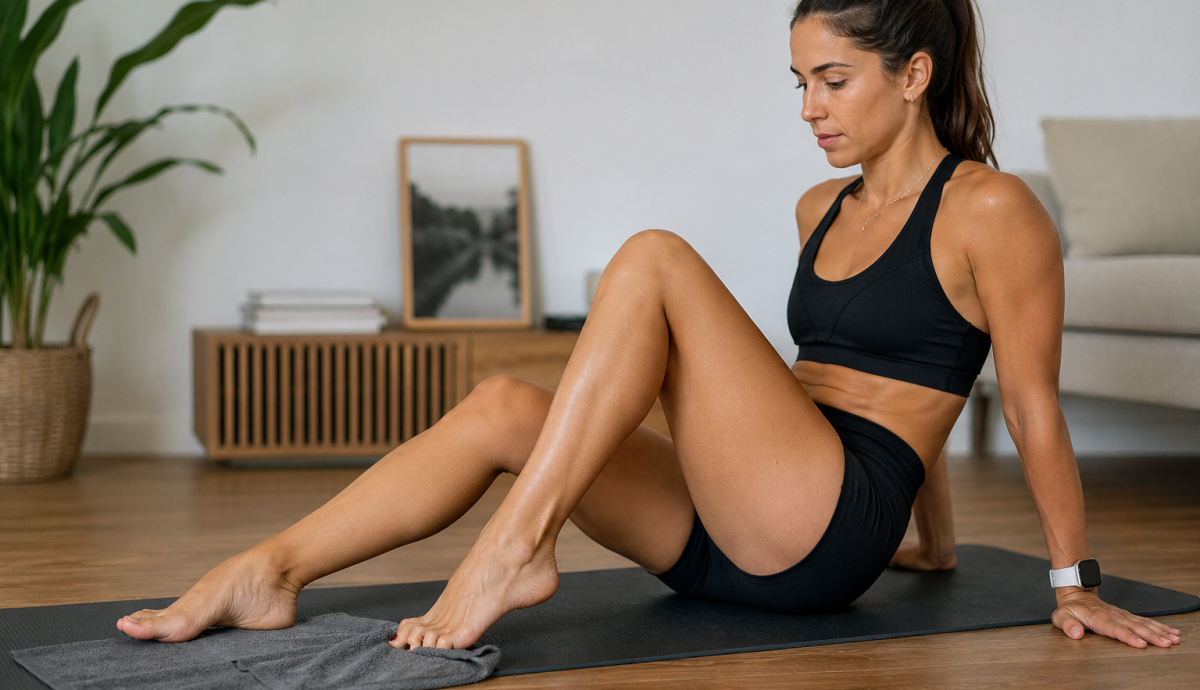
Squats, deadlifts, lunges, calf work, core exercises… We runners have learned that strength training is part of our preparation, and it is becoming less unusual to set aside one or more weekly sessions for it, whether our goal is to add sessions, run a 10k, or train for a marathon. Yet there is an area that participates in every single contact we make with the ground during those kilometers, and to which we still pay relatively little attention: our feet.
The foot is not simply the structure that touches the ground, but a complex system capable of adapting, stabilizing, and modifying its behavior as we progress through the foot strike, participating both in managing the forces we receive and in subsequent propulsion. And within that system we find muscles that, just like in other parts of our body, can also be trained.
Much more than 26 bones
When we talk about the foot we tend to think immediately of bones, joints, the plantar fascia, or tendons, but there is also an important muscular structure that we can divide, in a simple way, into two major groups: the extrinsic musculature, whose muscles originate in the leg and whose tendons reach to the foot, and the intrinsic musculature, formed by small muscles that originate and end within the foot itself.
These intrinsic muscles, among other roles, participate in controlling the longitudinal arch, the movement of the toes, and stability during the support, making their importance especially interesting when we consider a gesture as repetitive as running.
In fact, the specific work of the feet is not new in athletics. Historically, athletes have devoted a considerable portion of their preparation to strengthening feet and ankles, with mobility and proprioception exercises, toe work, stances, plyometrics, or various running technique drills aimed at improving the strength and control of this area. What has changed in recent years is our understanding of how it works and the scientific evidence that allows us to understand better why it is worth training it.
In 2015, Patrick McKeon and his team proposed in the British Journal of Sports Medicine the concept of the “foot core”, establishing a parallel with the lumbo-pelvic core and presenting the foot as a system in which three components interact: the passive structures, such as bones, joints, and ligaments; the active ones, fundamentally muscles and tendons; and the neural elements, responsible for receiving and processing the sensory information needed to control movement.
The idea is especially interesting because it provides a scientific explanation for something that on the track had been worked on long before: the foot is not a rigid base on which the rest of the body runs, but an active structure that needs strength, mobility, and control to respond to the demands of each contact.
What do our feet do while we run?
With each stride the foot faces two seemingly contradictory needs. During the stance it requires some capacity to adapt and manage the loads coming from the ground, while subsequently it must become a sufficiently stable structure to transmit forces and help propel us toward the next stride.
The intrinsic musculature participates precisely in that dynamic control, and various investigations have studied how it intervenes in the regulation of the arch and in the absorption and propulsion phases. McKeon and Fourchet described in 2015 its role in these two functions during dynamic activities, reinforcing the idea that these small muscles have a much greater importance than we have traditionally assigned to them.
For a female runner, there is also another important element: repetition. A single contact may seem insignificant, but during a training we perform thousands, and the foot must keep responding when we have been running for an hour and fatigue begins to alter our ability to control movement.
Therefore, working the foot should not be understood as something independent of leg, ankle, calf, glute, or core strength training, but as one more piece within a chain that needs to function in a coordinated way.
Proprioception: the foot also needs to feel
Strength is only part of the equation. To stabilize ourselves we need to constantly know what is happening under our feet, and that is where proprioception and plantar sensory information come into play, allowing the nervous system to make small adjustments based on our position and the ground we move on.
We do it continuously without being aware of it. A small irregularity in the ground, a change in incline, or simply a modification of our position during the stance triggers neuromuscular adjustments that help us maintain control.
That is why, when we train the foot, it makes sense to incorporate also single-leg balance and neuromuscular control exercises, starting with simple situations and progressively increasing the difficulty when we are able to keep a good position.
A strong foot means fewer injuries?
Here it is worth being especially cautious because it would be tempting to establish a direct relationship between strengthening the feet and staying injury-free, but running-related injuries are multifactorial and no single exercise can guarantee they will not occur.
There are, however, very interesting studies.
A randomized clinical trial conducted by Taddei and colleagues (2020) followed for a year 118 non-professional long-distance runners. Participants in the intervention group initially performed for eight weeks a specific program focused on the muscles of the foot and ankle and then continued with the training; during the 12 months of follow-up, the control group showed a probability 2.42 times higher of suffering a running-related injury than the group that had completed the program.
The same researchers published another study in which they observed that a specific strengthening protocol managed to increase the volume of the intrinsic musculature of the foot and modify certain propulsive forces during running, which demonstrates that these muscles respond to training and that working on them can have consequences for the mechanics of running itself.
These results are sufficiently interesting to warrant attention to foot strengthening, but not to claim that performing these exercises will keep us injury-free. Training load, recovery, overall strength, our past injury history, and many other factors continue to form part of a far more complex equation.
Five exercises to start training our feet
The good news is that working this area does not require a full gym session. We can incorporate a few minutes into strength training several times a week and progress just as we would with any other musculature: first learning to control the movement and later increasing the difficulty.
1. Short foot or shortening of the foot: with the foot fully planted and the toes relaxed, try to gently bring the heads of the metatarsals toward the heel without bending the toes, seeking a slight raise of the plantar arch. We can start by holding the contraction for five to ten seconds and perform between 8 and 10 repetitions per foot; once we master the movement, we can do it seated, then standing, and later on on one leg.
2. Toe separation and control: try to spread the toes as much as possible without lifting them off the ground and, subsequently, practice independent movements, lifting the big toe while keeping the other four toes on the ground and then perform the opposite movement. At first it can be surprisingly difficult, precisely because we are asking the nervous system for a control that perhaps we have gone years without consciously demanding.
3. Calf raises while maintaining an active base of support: perform a heel raise while paying attention to maintain contact of the first metatarsal, the fifth metatarsal, and the heel as references for the support, avoiding the foot from collapsing inward as you rise. Once controlled with both legs, we can progress to single-leg raises and, subsequently, add load.
4. Single-leg balance: hold the single-leg stance for 30-60 seconds, trying to keep the foot stable and the knee controlled; when it becomes easy we can introduce movements of the free leg, small reaches with the arms, or slight knee bends, gradually increasing the challenge without sacrificing the quality of the movement.
5. Sensory work with different surfaces: walking in a controlled manner on surfaces with different textures can provide varied sensory stimuli to the plantar surface of the foot, though here the objective should not be to seek increasingly difficult surfaces, but to pay attention to the support and our ability to maintain control as the information we receive from the ground changes.
You do not need to do them all every day nor accumulate hundreds of repetitions. Ten minutes, two or three times per week can be enough to introduce this work into our routine, always prioritizing correct execution and progressing little by little.
