
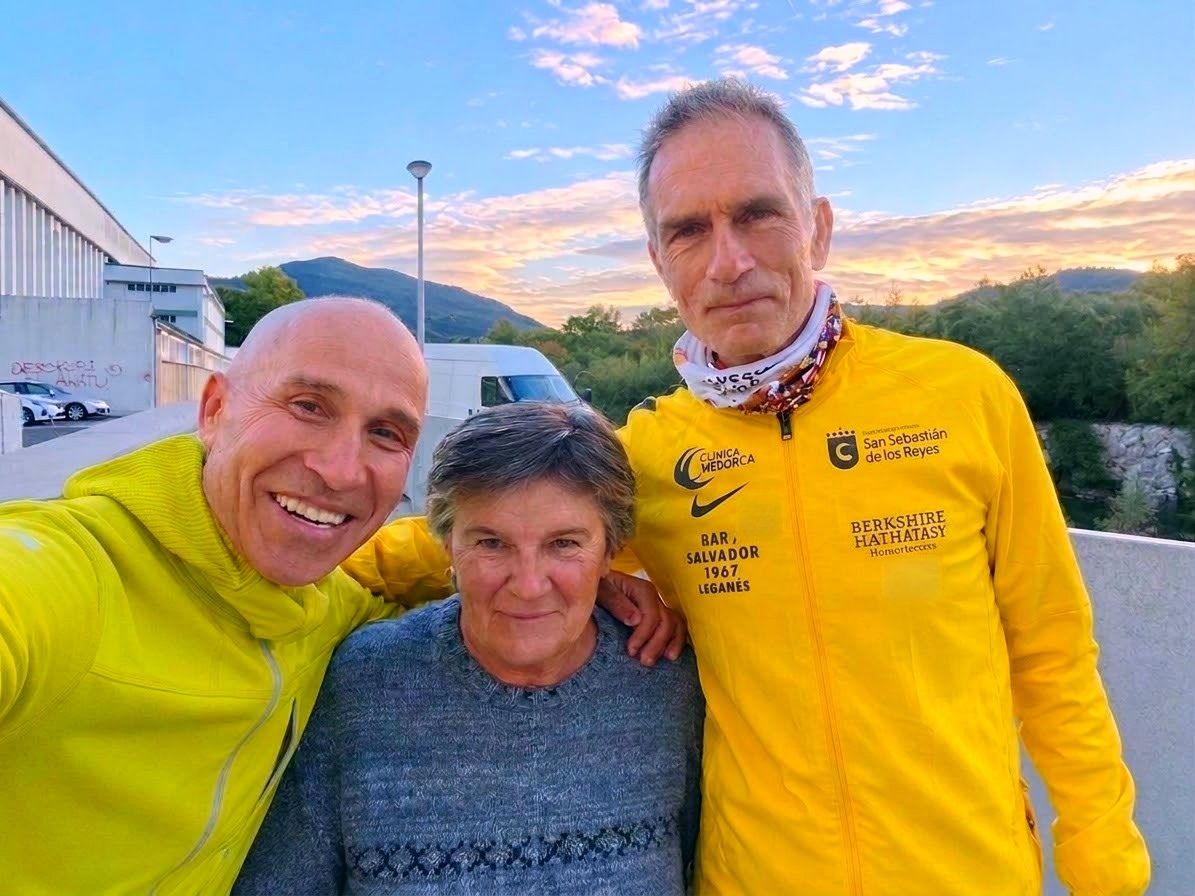
This Saturday, after lunch at Lasarte with other runners, I went for a stroll along the river with my friend Aurelio Olivar. As we began to walk, we asked a woman who was heading in the same direction what the river was called. It was the Oria, and that charming woman was María Luisa Irizar.
We kept walking by her side, and when we told her that the next day we would be taking part in the 20-kilometer Behobia-San Sebastián race, she told us that her father, Francisco Irizar Zarauz, had taken part many times in the Lasarte and Elgoibar crosses. She spoke with a certain pride that he had competed on two occasions (Glasgow, 1952, and Lasarte, 1964) in the Cross de las Naciones, the former world cross country championship.
When we asked whether she or her siblings had also practiced athletics, came the big surprise.
With complete naturalness and humility, she told us that she had begun to run in school and that she had won seven times the Behobia-San Sebastián and three times the San Sebastián Marathon. Precisely in this last event she achieved in 1991 her Spanish marathon record, with a time of 2 hours, 36 minutes and 28 seconds.
With a touch of sadness she confided that she would have liked to participate in the Olympic Games. In Seoul 1988, despite being the Spanish marathon champion, the Spanish Federation did not take her due to budget constraints. Four years later, when the Games were held in Barcelona, it was pneumonia that prevented her from competing.
She also told us that, before many competitions, she had worked early in the morning at her farm in Orio. A farm where, incidentally, she still lives.
We said goodbye to María Luisa on the bridge that led to the Lasarte Racecourse.
It was a wonderful coincidence to meet her. Sometimes, a simple riverside stroll grants the privilege of meeting someone whose story deserves to be told.

Dylan Holloway