
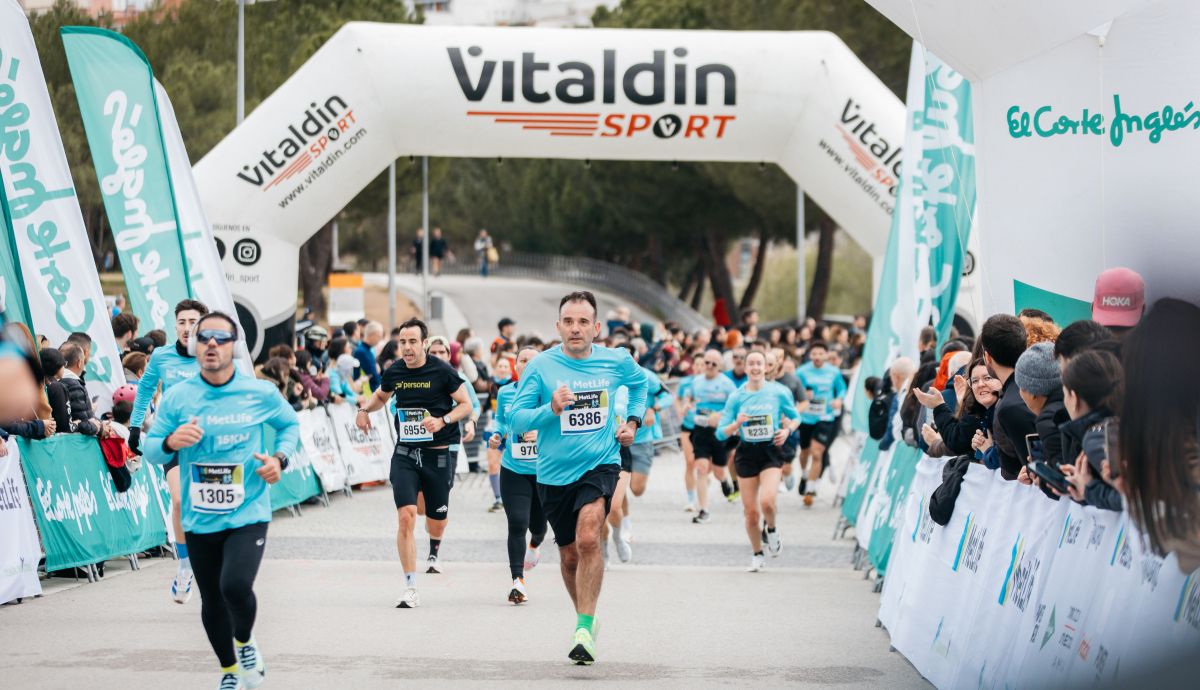
There are many runners who don’t dare to tackle distances as long as the half marathon, and even less the full marathon, yet they consistently race up to 10K. So, why not try intermediate distances, such as 15K? The training hardly changes at all and it’s basically one more step, with almost no risk. This way you can dispel the fear of longer distances.
10K races, or shorter distances, are the majority of races organized today. They run year-round, and you can choose from dozens each weekend. They represent the first competitive contact for any amateur runner. And they can be considered the sport’s great training ground. If half marathons are the stepping stone to the marathon, races of 5 to 10K constitute the first encounter with competition for the casual or amateur runner. They serve to begin in competition and are as varied and heterogeneous as can be. This type of race gathers the vast majority of runners, and the number shrinks noticeably when you look at much longer distances such as the half marathon. That’s because the leap to doubling the distance induces vertigo in many runners. The best way to conquer the fear is to try a 15K. It’s a distance that hardly requires changing the training and is a simple, low-risk intermediate step toward the half marathon. Therefore, from here we propose two training plans to attempt the 15K transition; one is basic and the other more advanced.
I have selected the target as the 15K MetLife Madrid, which will take place on February 28. It features a very central and beautiful route and is fast, since the profile is downhill. The highest point is the start, on La Castellana (near Plaza de Cuzco), and the lowest is the finish, next to Parque del Oeste. Do not leave registering to the last minute because there are only 10,000 spots and they sell out.
SIGN UP HERE FOR THE METLIFE MADRID 15K
It’s an ideal course for a debut, because almost all of it is downhill, which makes things a lot easier. It’s perfect for posting good times and beating personal records. And it’s also an excellent test before competing in the Movistar Madrid Half Marathon, which takes place two weeks later.
The basic plan is designed to help those runners who want to begin this distance with the aim of finishing with good sensations and in a time around 1h25’ (at 5’30’’ per km). It’s a very easy-to-follow plan that requires only three days of training per week and could be followed by anyone who exercises regularly and has competed several times at shorter distances.
The advanced plan is aimed at regular 10K runners (who typically run them in about 50’ or less) and whose goal is to drop under 1h17’, or even under 1h16’, in the 15K (which corresponds to an average pace of 5’08’’ or 5’04’’ per km).
TRAINING PLANS
If you shift the order of training days, you should always do so keeping in mind that you should not train more than three days in a row; the ideal is to do two consecutive days and take a rest day.
The times I propose in these tables are indicative and approximate. Do not treat them as “hard rules”; they are references from which you should calculate your training paces. The best way to avoid mistakes is to err on the cautious side and err on the generous side (especially with the intervals). You should consider that if the last interval isn’t the fastest, or if as you reach the last third you’re slower than in the earlier parts, you’re doing them wrong; that is, too fast for you. If you do them in progression, finishing the last ones stronger, but you don’t recover at least 30 beats per minute within a minute, that means you’re going too hard and you should reduce the pace in the next session.
What Everyone Should Know
Training should be undertaken with moderation; it’s better to err on the side of underdoing than overdoing.
The easy runs are best done in places with climbs and descents; this way you’ll also improve muscular power.
Why do intervals or repeats? Because they improve many physical qualities. They help train the body to respond to the different demands that will later be required in competition. They lead to an increase in maximal exercise performance, a spectacular improvement in the body’s maximal effort capacity, and a higher lactate tolerance, as the body learns to recycle lactate. They increase cardiovascular efficiency due to the higher oxygen demand; the heart grows, and muscular blood perfusion improves. In short, these workouts train aerobic power, which is the quality that will allow you to use a high percentage of your maximal oxygen uptake during the race and thus achieve higher performance.
The consistency, patience, moderation, and rest make it possible to increase training loads, which will enable you to develop your maximum performance capacity.
Stretch after every training session. Hold each stretch for 8 to 10 seconds. Focus on the muscle you are stretching. When done correctly, stretches help the muscles return to their original position, relieve significant tension, facilitate drainage, and stimulate greater blood circulation. The proper way is to stretch with relaxed, steady tension, paying attention to the muscles being stretched. The incorrect way is to stretch with bouncing, jerking, or forcing the muscle too much.
Ankles. Performed in a straight line of about 30 m, with a very light jog to recover.
- Lateral Run. Arms forward and backward, coordinated with each jump.
- Short strides lifting one knee, then switch. Coordinating well with arm movement, bringing the elbow back and up as much as possible.
- Short jumps, heel-to-toe, with hardly any knee bend.
- Normal skipping. Pulling the arms, with elbows flexed.
- Backward skipping.
- Step leaps, with the same leg, switch at halfway.
- Bounding jumps. Very wide leaps on each leg.
- Run almost in place, heel-to-toe.
- Frog jumps with feet together.
- Run on tiptoes without bending the knees, hardly moving and pulling a lot with the arms.
Flat sprints are done after finishing the ankle exercises or the long progressive runs; they consist of short progressions (on a flat straight of about 40 to 50 meters), at a lively pace, but not at full tilt. They should be done by greatly extending the stride and lifting the hips.
In short: consistency, patience, moderation, and rest make it possible to increase training loads, which will enable you to develop your maximum performance capacity. If you can avoid interruptions in training, you’ll gradually see your body able to assimilate more and better the workloads.
