
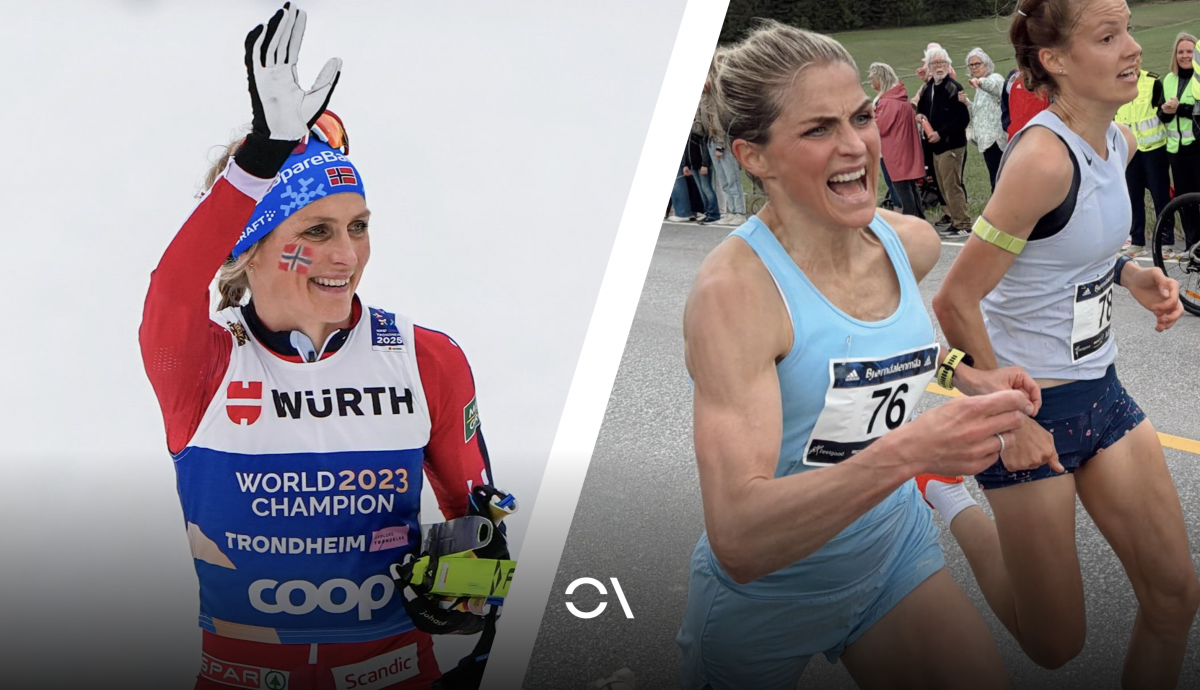
Therese Johaug is showing that her extraordinary endurance can also translate to athletics. The Norwegian has posted 30:51 for 10 kilometers and 1:08:43 for the half marathon, two marks that confirm her move to the asphalt goes far beyond a post-retirement foray from cross-country skiing. The half marathon was completed in Copenhagen last September 20, in the race alongside the world championships for the distance, while this weekend she ran the 10 kilometers at the Hytteplanmila in Norway, delivering an impressive 30:51.
View this post on Instagram
From dominating cross-country skiing to pursuing the 2028 Olympic Games
Johaug is one of Norway’s premier endurance athletes. Her résumé includes four Olympic gold medals and 14 world titles in cross-country skiing, a discipline in which she stood out for more than a decade thanks to her ability to sustain long efforts. Her career also serves as an example of how cross-training can lay down a massive aerobic base by combining different disciplines.
If she earns a place for the Los Angeles 2028 Games, she would be 40 years old.
Now she wants to test how far she can go with running shoes. Her next big challenge, according to this magazine, will be to debut in the Valencia Marathon, before evaluating the possibility of contending for a place at the Los Angeles 2028 Olympic Games. Born in June 1988, she would face that event at the age of 40. Valencia would be her first major test over the 42.195 kilometers, a distance that demands far more than simply translating her 10k and half marathon times.
The doping sanction that divided Norwegian sport
Her career was also marked by a positive test for clostebol in 2016, after she used a cream to treat sun-induced lip burns. Johaug argued she had trusted the national team doctor, who supplied the product without properly warning that it contained a prohibited substance. The Court of Arbitration for Sport (CAS) did not dispute that the substance came from that cream, but rejected that all responsibility lay with the doctor: it concluded that Johaug had violated her duty to check the ingredients and the anti-doping warning on the packaging. As a result, it increased the sanction from 13 to 18 months, initially imposed by Norwegian sports authorities.
Many fans felt she had been the victim of an error by her doctor, who took responsibility and resigned.
The case sparked a huge debate in Norway, where Johaug maintained strong public support. Many supporters believed she had been the victim of a doctor’s mistake, who took responsibility and stepped down. However, that social backing did not alter the sporting ruling: Johaug served the 18-month suspension and missed the Pyeongchang 2018 Winter Olympics. Her case became one of the most media-covered episodes in Norwegian sport, precisely because of the gulf between public perception of what happened and the criteria applied by the CAS.
