
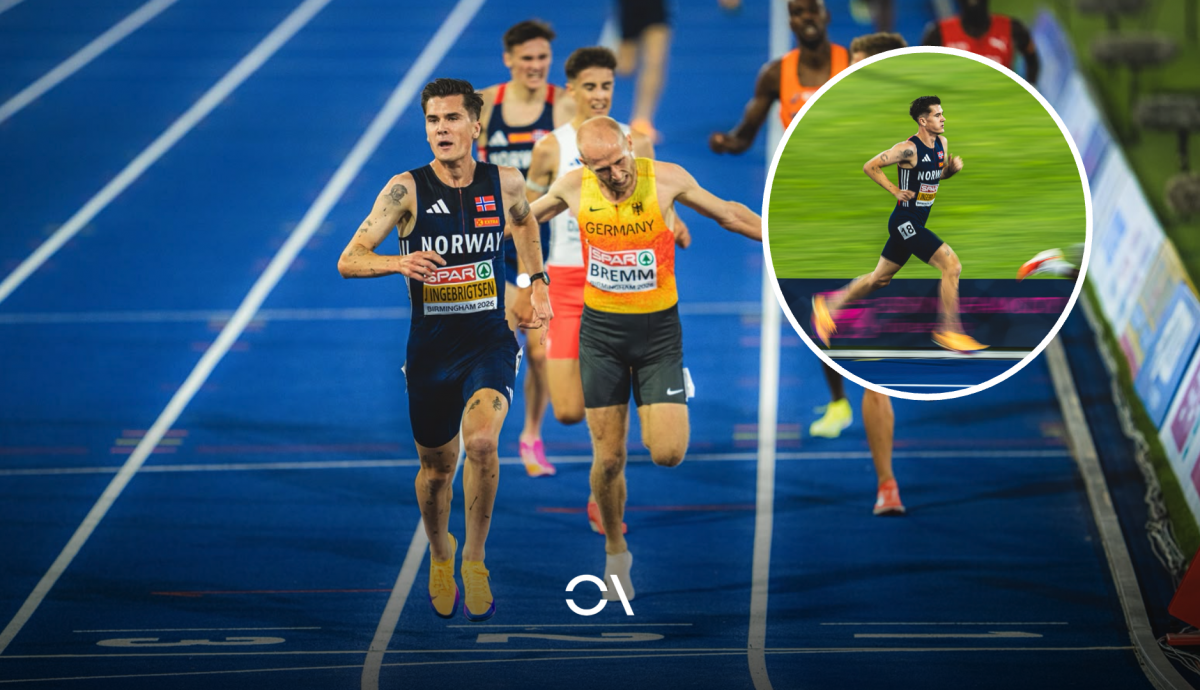
Jakob Ingebrigtsen returned to competition nearly a year after his last race, and did so by becoming the European champion in the 5,000 meters. But behind that Birmingham gold there is more than a race and a result: the data allow us to understand how the Norwegian began to reclaim sensations and, above all, how he chose to trust that he was ready to compete at the highest level again.
The COROS records during the final show a race that built gradually from a slower start: Ingebrigtsen crossed the first kilometer in 2:48.3, still well short of the pace he would impose, and then accelerated progressively: 2:42.3 in the second, 2:39.8 in the third and 2:38.7 in the fourth. But the real display came in the last kilometer, completed in 2:26.2.
And the data for the final meters are even more emphatic: 54.79 seconds for the last 400 meters, with an average cadence of 212 steps per minute and a peak of 226. In the last 100 meters he ran in 12.69 seconds, reaching those 226 steps per minute.
His average during the race was 180 beats per minute, while the maximum recorded was 188.
It is also meaningful to observe the heart rate. His average during the race was 180 beats per minute, while the maximum registered was 188. In the last kilometer the average had risen to 183 and, in the final 400 meters, he reached 188 as a maximum. In other words, the final spurt did not come solely with an increase in speed: it also came with a physiological response in line with the effort of a European final.
A race built with data
Ingebrigtsen has explained that the numbers could not guarantee that he was ready to win again, but they did allow him to verify that his body was recovering the necessary level.
“The data don’t give you certainties. They give you something to work with. But the numbers showed me that I was returning to the point where I needed to be. At some moment you have to trust that and compete.” And that is precisely what he did in Birmingham. After barely three weeks of solid training, the Norwegian understood that he did not need perfect preparation to return to competition. He needed to know where he stood and to make the most of that form. “Three weeks of good training isn’t a lot. But it’s enough to gain some confidence,” he explained after the race.
From 188 to 226 strides per minute
One of the most striking indicators is the evolution of cadence. In the first kilometer, Ingebrigtsen posted an average of 188 steps per minute. In the second it was 190; in the third, 191; and in the fourth, 192.
But in the last kilometer the jump was considerable: 204 steps per minute on average. And when the final attack arrived, the cadence surged to 212 steps per minute during the last 400 meters with a peak of 226. The data help to quantify one of Ingebrigtsen’s most recognizable images: his ability to shift gears when the race enters its decisive phase.
His final 54.79 seconds equates to running those last 400 meters at a pace close to 2:17/km, well below the race’s average pace, which was around 2:39/km.
“The goal is never to have perfect data”
Technology has helped Ingebrigtsen throughout this past year to interpret how his body was responding after a season marked by physical problems and his absence from competition. But the athlete himself insists that data are a tool, not the objective.
“COROS has helped me understand the process over this last year. I get the information I need to know how I’m responding and where I can improve. But the goal is never to have perfect data. The goal is to run faster. Sometimes you have to trust your training and go for it.”
“After all that has happened, winning is obviously special. But for me, the most important thing is that I’m back competing and I’m healthy. The title is the result. Returning to this level was the real process.”
The data account for one part of the story: 13:15.29, 2:26.2 for the last kilometer and 54.79 for the last 400 meters. The other part was told by Jakob Ingebrigtsen on the track: he returned, trusted his preparation, and won again.
View this post on Instagram

Dylan Holloway