
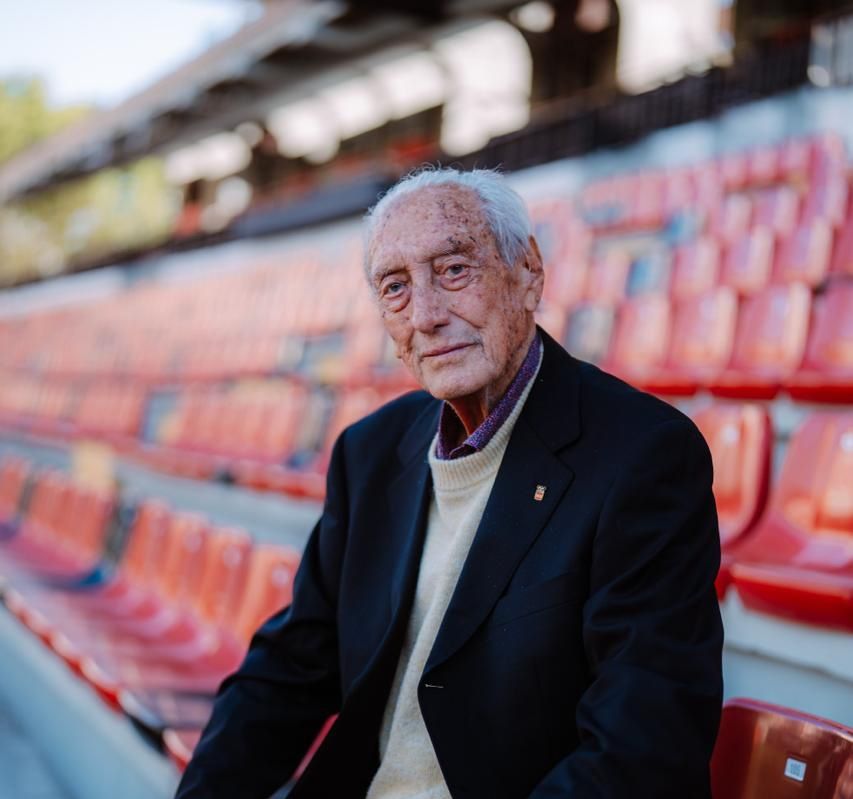
►►► AFTER THE DEATH OF ANTONIO SABUGUEIRO, WE WISH TO HONOR HIM BY PUBLISHING THIS
INTERVIEW CONDUCTED BY ÁLEX CALABUIG IN 2019 AND PUBLISHED IN CORREDOR MAGAZINE IN 2020
Born in Rúa dos Fornos (Ourense), Antonio Sabugueiro built, with great effort and imagination, a solid reputation in the world of sports organizations until he managed to create and establish the finest San Silvestre race in the world, the Vallecana. His passion started early, as the director of the Jardin Institute, who was a Latin professor, asserts that Antonio constantly asked him to organize events, purchase sports equipment, and form teams. A father of three and a proud grandfather, he lives in Collado Villalba in a small house that more resembles a museum of athletics history, surrounded by photos, paintings, trophies, plaques, diplomas and well-deserved recognitions for tireless work in the world of sport.
Antonio, how did the idea for the Gran Premio de Vallecas come about in 1964?
I was the provincial head of the Madrid city sports activities services and I had two assistants, Manolo and Carlos. We organized cross-country races on a voluntary basis in the Casa de Campo, at least once a month on Sundays. The paradox was that the Vallecas local chief had more money than I as provincial chief, because he spent little while I had to serve all the districts of the capital. This man went around to companies and gathered financial support. He had a surplus I didn’t have. I needed 5,000 pesetas for a planned sports activity and I told Carlos that we should go see Ramón Sánchez Anaya, the Vallecas local chief, to ask for help, and that’s what I did. I presented him with a budget for the trophies and he accepted it. I had no money, but I did have plenty of imagination.
“The race was born somewhat as a joke in the Bella Luz tavern, while I was having a beer with my assistants. I told them: What’s with this always organizing cross-country events and getting knee-deep in mud? We have to create a race on asphalt.”
Is it true that the race was born in a bar?
Yes, it happened more as a joke in the Bella Luz tavern, while having a beer with my helpers Manolo and Carlos. I told them: “What’s with always organizing cross-country tests and getting covered in mud? We’ve got to create a race on asphalt.”
Where does the name San Silvestre Vallecana come from?
The first edition of the race was very modest, with fewer than 60 participants, but because I relied on imagination I gave it a name that sounded very fitting, Gran Premio de Vallecas. I said: “Let’s make sure the name sticks! Ha, ha, ha…”. I recall there being no traffic guards, and my friends Carlos and Manolo even had to act as guards because buses descending Peña Prieta wouldn’t stop and almost ran over the runners. My friends had to be firm and board the buses to force the drivers to stop.
As an anecdote from that first year, the winner was the great Real Madrid athlete Jesús Hurtado, who had so few resources that he ran the race in the same shirts with which he went to work. He didn’t even have shoes. He worked near El Retiro and came from Plaza de Castilla, and he didn’t have money even for the subway, so he ran.
Another thing I remember is that I copied something. I used to go every year to the Cross of Lasarte; I was in love with that cross-country event. They displayed the prizes the winners had won at the town hall and announced the winners in order, who could choose the prize they liked best. There were even shotguns. I imitated that model, and it’s one of the few things I copied, because I’ve always been original.
In the early years the event wasn’t held on December 31 but on the last Sunday of the last month of the year. I was friends with the main journalists of the time, and I also read and collected MARCA from the age of ten. I remember that one Monday of the second year I read in the newspaper a piece by José Luis Gilabert: “Madrid already has its San Silvestre, the San Silvestre Vallecana.” I called him and he told me that he had written that name, naming the event that way so I could use it if I wanted. And I did. In the third year it was called San Silvestre Vallecana.
Did you draw any inspiration from the San Silvestre de Sao Paulo, founded in 1925?
People have always accused me of that, but at the time I hardly knew about the Sao Paulo race. And the fact that I did not want to imitate anyone is evidenced by the person who gave the name San Silvestre being José Luis Gilabert.
What support did you have in the early years?
The MARCA newspaper helped me a lot. Also the Pueblo newspaper, which was the most important in Spain. My friend Paco Chico Pérez, who wrote about cycling for Pueblo, supported me greatly and told us to go see the director, Mr. Emilio Romero, to help with the event. And Pueblo became the first official newspaper of the San Silvestre.
How did you manage to attract many of the world’s best runners to Vallecas?
The San Silvestre Vallecana has always been a leader in innovation. The first manager who came to Spain, I recruited. His surname was McDonald. I arranged for an interpreter so he could speak with the federations of various countries. Back then there were no fixed starting points, but in the third year we paid 15,000 pesetas to Javier Álvarez Salgado. The first sponsor the race had was La Casera, through Rayo Vallecano. And since Rayo Vallecano was involved, which people had a great affection for, it drew a larger audience at the event who cheered and encouraged the contestants. Rayo fans also helped a lot, as they went through Vallecas collecting shoes, bottles, a bit of money… In those days you had to invite the president of the athletic federation of whichever country you wanted; if the president didn’t come, he delegated to whom he deemed appropriate. What I did was take them to Los Canasteros, a flamenco venue, to gain notoriety. The first important athlete I brought was Mohamed Gammoudi, a Tunisian soldier who had won the Cross of Nations and the Olympic gold in the 5000 meters at Mexico City 1968. He came accompanied by a captain, acting as his delegate. This man enjoyed it so much that the next year he wanted to repeat, but he clashed with his boss and Tunisia never returned to the race.
When did you start paying the athletes?
Thanks to my great friend and excellent athlete Tomás Barris. In the Nordic countries, he already received payment when he went on the circuit of races, and he told me that I had to start paying. And that’s when I paid Álvarez Salgado. I must say Tomás also acted as an interpreter with the athletes; he threw himself into it with me.
I imagine in the early years there were even problems closing the streets…
The editor of Pueblo, Emilio Romero, supported the race and his newspaper was the official daily, but he asked that the race begin on Huertas Street, where his office was. I went to see Lieutenant Colonel Luque, head of Madrid traffic. I explained the matter and he looked at me seriously and said, “Are you out of your mind? Do you want us to close Atocha Street at eight in the evening on December 31? You don’t know what you’re saying!” After that conversation I spoke with the Director General of Madrid Services, Mr. Santiago Estrada, who was above Luque, and he signed the first permit for a popular race to run through the streets of Madrid.
When did you realize the race had become an internationally recognized phenomenon?
In the fourth edition, in 1967, with a world and Olympic champion like Gammoudi winning the race, we took that step. With La Casera’s support we already had money, and the process of bringing top athletes grew crescendo. I think some 80 or 90 of the best Spanish runners in history have participated in the San Silvestre Vallecana. From Javier Álvarez Salgado onward they began to be paid. Banco Central came in as a sponsor and others followed. And the Rayo Vallecano was key in spreading the event and ensuring the best participants came. We have had José Luis González, Martín Fiz, Fermín Cacho, Vincent Rousseau, Arturo Barrios, Carlos Lopes, Osoro Ondoro and many more.
How did the San Silvestre Popular come to be?
Gabilondo invited me to his program, and there was Pepe Domingo Castaño, who told me we should do something for the non-elite participants, and from that idea the popular race was born.
What can you tell us about the godmothers the race had?
I told Paco Chico Pérez, of the Pueblo newspaper, that for the event’s presentation we could bring godmothers. He arranged that the person who worked on society pages would recruit the celebrities to come to the presentation and to fire the starter’s pistol. I have an anecdote from the year Rocío Jurado and her husband Pedro Carrasco came. A huge crowd gathered before the start to approach them. I kept the 75,000 pesetas for the race budget in my right pocket to pay prizes, travel, and athletes’ expenses. In the midst of the commotion, a man over seventy reached into my pocket and tried to steal from me. Thank goodness I grabbed him and managed to stop him. If that had happened today there would be no race. Imagine! Hotels, airplanes, and buses would all go unpaid…
There were other very famous sponsors, such as Rocío Dúrcal, Ágata Lys, Karina, Bárbara Rey, Mari Cruz Soriano, Teresa Rabal, Analía Gadé and many more.
Alongside this, women began to participate more and more in the race, right?
Women participated from the very first year, although some people have claimed otherwise; the truth is they were women who competed for their clubs. I kept the classifications. Years later the world’s best athletes ran, such as Grete Waitz, who earned a substantial bonus.
The San Silvestre Vallecana is the second oldest in Spain after Galdakao, but soon became the most important in our country. As a result, it became a model for many San Silvestres in other cities. What is your view on that?
No country in the world has more than 1,000 San Silvestres. They emerged under the umbrella of the San Silvestre Vallecana. I did not promote the popular race because there were no resources. All the money went to the International, but when Nike entered as sponsor they provided runners with a good shirt and better services, which greatly boosted the Popular and led to San Silvestre events in other places.
On the other hand, the first charitable races we organized in Spain were ours and they were against juvenile alcoholism and a staged race in favor of Ortega Lara’s freedom. These actions contributed to the running movement.
What did Nike’s entry as a sponsor and Last Lap as the organizing company mean?
Today everyone talks about running, but that term Nike brought to Spain. They launched a campaign with good coaches in El Retiro to prepare runners and give them advice. It is something that had never been done here. Nike launched impactful advertising campaigns that cost a lot of money, and for many years we formed a big family. As for Last Lap, they have contributed from the start with a high level of organizational professionalism that is essential for success. And in recent years, with the sponsorship of Nationale-Nederlanden, members of the world’s best athletics team come to run.
“Eliud Kipchoge won the race in 2005 and 2006, achieving an impressive time, under 27 minutes. Last year he sent me a bracelet, the book of his life, and a signed shirt. It was a wonderful gesture that I cherish dearly.”
In Vallecas, even Eliud Kipchoge has triumphed…
He won in 2005 and 2006 and set the world best 10 km on the road, although the course is not homologated. I recall that people threw a lot of foam at him, even though from the vehicle I was shouting for them not to do it. He finished covered in foam. Eliud sent me last year a bracelet, the book of his life and a signed shirt. It was a wonderful gesture that I treasure highly.
There is a curious phenomenon with the San Silvestre Vallecana. Some people only run this race all year long…
The event’s reach is worldwide. We were awarded the IAAF Gold Label, the highest distinction that exists. The event has grown a lot, and I’m very happy that all those people participate on December 31.
What makes the Vallecana special today?
It is known all over the world. Since December 31, people are looking to end the year by running, and there is no race on the planet with the energy that ours has in the streets. From Atocha to the finish line it’s impressive. The Vallecanos want this race with a passion. The start is spectacular, with five waves and a fabulous show. Radio, television and newspapers throw themselves into it. And it is a race whose president of honor is His Majesty the King. We awarded him the Golden Silvestre in the awards we organize each year. This distinction has never been given away; we have handed it to outstanding athletes and politicians who have supported it, etc. The mayors of Madrid have helped the race. This year I’ll give you a scoop, José Luis Martínez-Almeida will run.
Is San Silvestre Vallecana a race with a special energy?
Of course. Vallecas throws itself into it wholeheartedly. As an anecdote I can tell you that one year, even though the event would coincide with a Madrid-Atleti football match, during the media presentation they asked me about it. I answered very solemnly: “Look, Mrs. María can be in the kitchen roasting the lamb, the turkey, or the chicken, but when she hears the strains of the race, she will drop what she’s doing, roll up her sleeves, and come out to the street to cheer.” There will never be a shortage of people at this race to create an incredible atmosphere. The runners receive extra energy from the crowd. Many of the world’s best athletes have told me that the people lift them up and, even when they are fading, guide them to the finish.
“My cardiologist, who is a popular runner, told me: Antonio, you don’t know the great favor you’ve done to Spanish healthcare and the amount of money you’ve saved in medications for the healthful life you’ve generated.”
What does your cardiologist say about your work in the sports world?
He runs the race, and his wife does too. He told me: “Antonio, you don’t know the great favor you’ve done to Spanish healthcare and the amount of money you’ve saved in medicines due to the healthy life you’ve generated.” I used to travel to different parts of Spain and I didn’t see anyone running. Now everywhere you go there are people training. The San Silvestre Vallecana has decisively contributed to this movement.
Antonio, you have been an organizer and also a very active athlete. Do you still exercise?
I used to sign up for anything related to sport. Now, because of age, I can only do a few exercises at home. Sport has always been part of my life. Everyone associates me with the San Silvestre, but I have done many more things. I organized the Hispanidad March with the best walkers in the world. We left Madrid; seven days of stages finished on the Pilar day in Zaragoza at noon. I also led the Madrid International Mile, which was more important than New York’s. Unfortunately, it only lasted two years. Participants included Said Aouita, Fermín Cacho, José Luis González, etc.
There is much talk about the successes of the San Silvestre Vallecana, but there must have been very hard moments too, right? Even a year the event wasn’t held.
Yes, it was 1969. There was no race that year, among other reasons because my father passed away and because there was no budget. I was an executive of the fifteen sports sections, and a very boastful man with a Maserati arrived at the door of the Rayo Vallecano headquarters. He said he could do something much bigger. He spoke with the club president, Pedro Roiz, and said go ahead, but there was no budget, no subsidy. I was also a director of the Spanish Athletics Federation, and the president was Rafael Cavero. His family was multimillionaire and he paid out of his own pocket the athletes’ travel to world championships, provided housing, and so forth. This boastful man said he would take money from Cavero, but I think Rafa didn’t even say good night to him. In short, that year we had no help.
To finish, is there any anecdote you’d like to highlight from all those New Year’s Eves in Vallecas?
Oh, there are countless stories I could tell… For example, here’s a curious one. I didn’t own a car. One year, after the race, I had left my coat at the Rayo headquarters on Avenida de la Albufera. The janitor left with the key. Imagine December 31 at night, freezing cold, in a jacket, without a coat… I caught a cold that forced me to stay in bed for eight days. I spent the night alone, huddled in a Vallecas bar. I lived in La Cruz de los Caídos. At that time it was impossible to get a taxi; there were very few cars. I managed to catch one at three in the morning, after walking from Portazgo to Atocha.
