• CHECK HERE THE COMPLETE RESULTS OF THE SCIENCE RACE
• IF YOU WANT TO RECEIVE THE LATEST NEWS FROM THE RUNNING WORLD ON WHATSAPP, CLICK HERE.
THE SCIENCE RACE, AN EMPIRICISM SPANNING NINE FIVE-YEAR PERIODS
Life grows more complex, commitments pile up, and one must tread paths that take you away from places where you have always been happy and at ease. But as José Saramago wrote in his The Elephant’s Journey, and the brilliant Portuguese writer was not wrong, we always end up arriving where we are awaited. A commemorative edition, a neat round figure that transcends cardinality and ordinality to amass decades, is sufficiently enticing as a lure to escape the tangled commitments of the calendar and to stage a return after a few absences. An anniversary edition, indeed, is a great reason. And about 3,000 people have been clear about it, and not even the threat of rain kept them away.
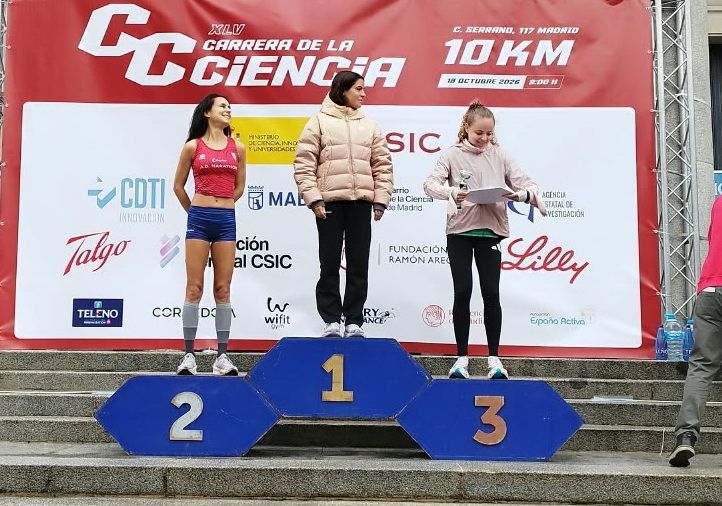
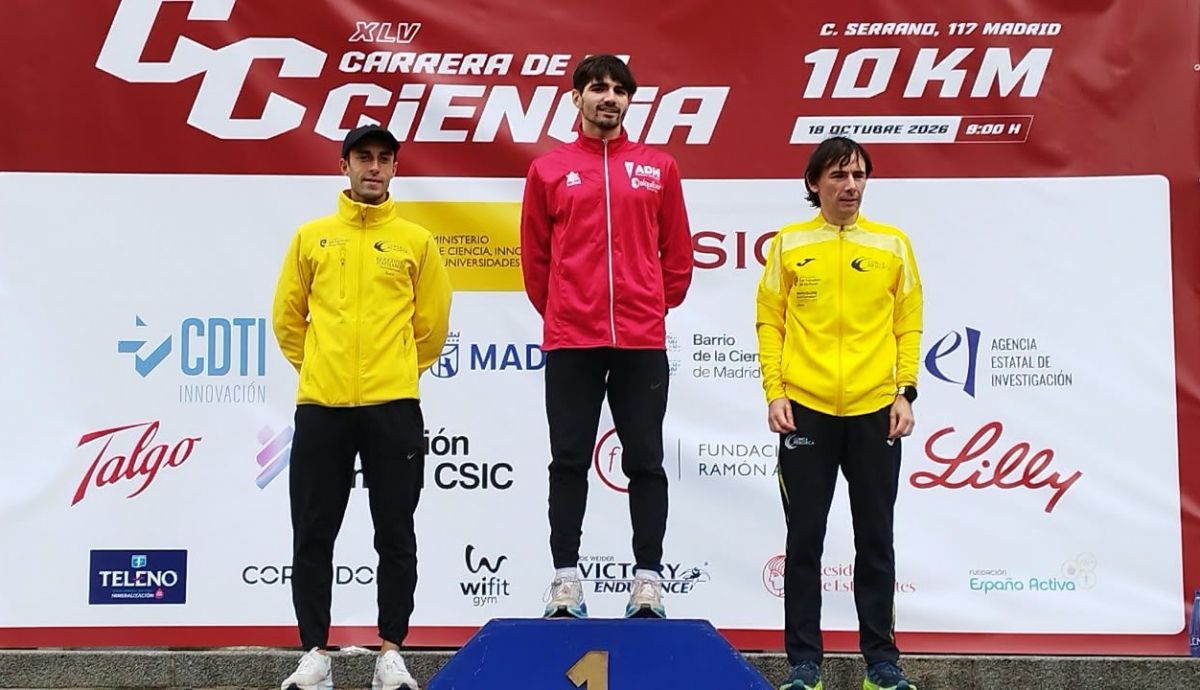
The Science Race celebrated this Sunday, October 18, its 45th edition, crossing the solemn finish line at the Consejo Superior de Investigaciones Científicas for two athletes who are also workers at the institution, Daniel Hernando (30:36), Marta Maza (35:38), and the figure was achieved on a gloomy day, with rain and at times wind, okay; but one of those days you also remember in the tales yet to be told. “That dog-day in the Science Race,” and so on. Well, the rain held up fairly well. But it is undeniable that the day, meteorologically speaking, has been a seasonal turning point. The all-terrain Javi Lázaro, good guy like few, one of those people who surf life with a smile, the Télemadrid reporter and commentator this Sunday at the start and finish, set it up in the prolegomenon: “It is the first day of autumn in Madrid.”
The course, the usual one. Ten kilometers that, in imaginative terms, could be summed up as a rectangle, although urban planning later handles it to spoil that polygonal integrity. And, true to its name, a lot of science. The empiricism of letting yourself go downhill, because if you accelerate more than you should you’ll burn out; the empiricism of watching out for the hills, some of which are quite visible, though short; and more caution with those that are almost imperceptible, but there and nibbling away, relentless, little scratches on your body’s battery. This brings us to the Paseo de la Castellana, which in the sense of the walk proposed by the Science Race is an inclined plane for four kilometers. “The Castellana is not flat.” No. And in 2026, an additional obstacle, how indigestible it becomes less than two kilometers from the end to pass through a section of Serrano Street undergoing repaving (and which reveals glimpses of the old cobbled surface, wonderful).
The Science Race, for many, the one at the CSIC, is a lovely adventure with a bit of scientific method, the experimentation of “downhill you let yourself go” and “uphill you brake”; and a bit of social sciences, of philosophy or linguistics, if you push us, because what a metaphor unfolds on the asphalt: that long and invisible ascent along the Paseo de la Castellana reaches its peak exactly where the Ministry of Economy, Trade and Enterprise is reached, which evokes the treasury, taxes, duties, levies, and various expenditures. A test that toughens you, that generates experiences that help you manage its physical peculiarities much better and, above all, negotiate your weaknesses. A race that makes you tougher.
The Science Race, come on, is a full sensory invitation, an invitation to open the mind and become aware of how vast and diverse the world is. At the clap of the shoes you pass from the Embassy of Japan to that of the United States, and from there to Portugal, in a flash. The adventure offers glimpses of old journalistic offices, Neo-Mudejar style, palatial façades, distinctive buildings, a few multinational-sounding offices, and a skylike cosmopolitan environment that, Sunday’s things and the keeping of faith, rests in a lethargy until Monday. Allow me not to mention here the stronghold of a soccer club, which already draws attention by itself without needing to highlight it, due to the perpetual erosion that football exerts on the media exposure of all other sports at the media level, as happens, for example, with basketball. The race, as you know, passes by the Ramiro de Maeztu College, cradle of the Estudiantes basketball team.
For many, ‘the Science Race’ is an essential date on their annual calendar of popular races. And for many more, a recurrent source of winter wardrobe thanks to its long-sleeve technical jersey, always long-sleeved, distinctive and unique. The Science Race, simply by virtue of the institution that sponsors it, is intangible heritage of the city of Madrid. And it is even more so by the fact, confirmed this Sunday, of reaching five five-year periods of existence, five five-year periods that in turn draw on pioneering experiences from a century ago.
The Science Race, simply by virtue of the institution that sponsors it, is intangible heritage of the city of Madrid.
That is why it feels strange, hard to understand, that when the City Council of Madrid draws up a list of races that can be contested within its center, a compilation that focuses especially on a participation of over 5,000 runners, no one thinks of a nod or gesture toward this event which, strictly speaking, was left out of the nineteen blessed for 2026, some of them as new as powerful economic forces behind them. It is understood, of course, only that the municipality seeks to reduce traffic cuts, extras from its local police, impacts on urban mobility, and disengagements in neighborhood coexistence. But the Science Race, which is true that it was born in Casa de Campo in 1980, is not “one more.” Since it implemented its current route in 1989 as part of the CSIC’s half-century, the event has weathered waves and booms of the popular athletics phenomenon, without demanding, without claiming the value it truly has. The race does not need the central lanes of La Castellana; along the right margin it runs fantastically and climbs upward. Participation cannot always explain everything; tradition also deserves a minimum of respect for all those years of promoting science, physical activity, and popular sport. Only a few hours remain for you to experience it firsthand in the 2027 edition. A race with a special atmosphere.
• CHECK HERE THE COMPLETE RESULTS OF THE SCIENCE RACE