
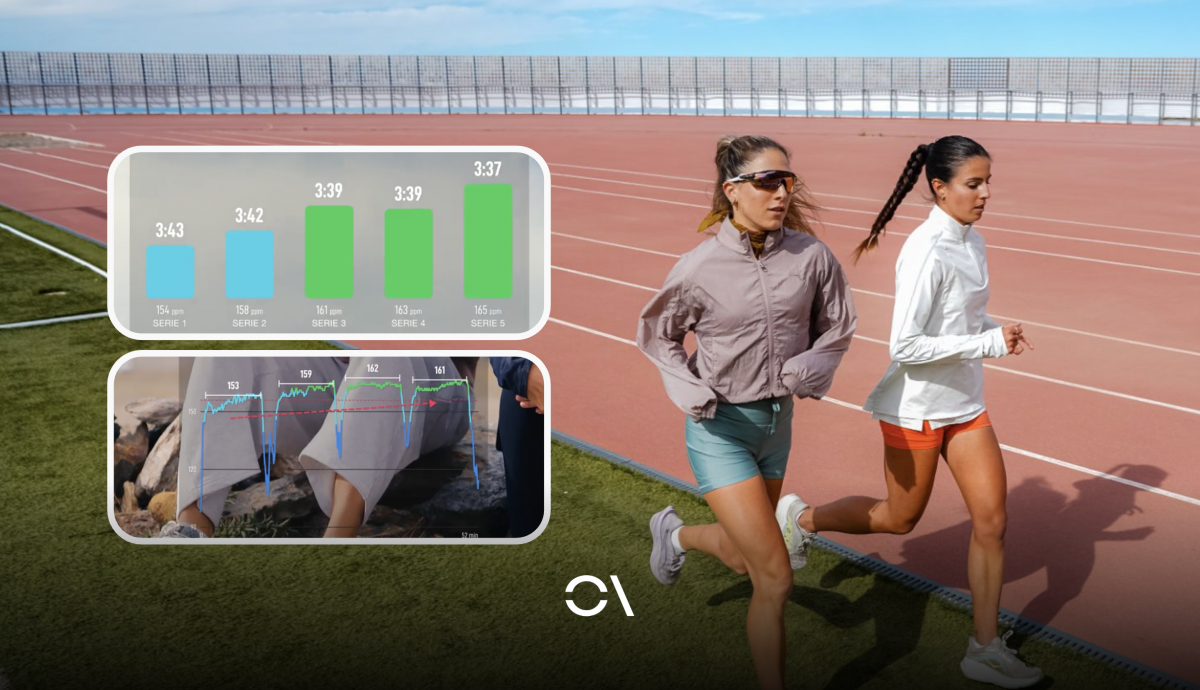
Carla Gallardo and Andrea Romero are squeezing in the final training sessions before tackling this Sunday’s Valencia Half Marathon. The two athletes have chosen Sierra Nevada to prepare for the event, with high-quality altitude workouts and thorough monitoring of their physiological data thanks to COROS technology.
In a location situated above 2,300 meters in altitude, both have trained with 3,000-meter intervals, adjusting the pace and monitoring the body’s response. The aim is to reach the starting line with the sensations and effort under control in one of the last demanding sessions before the competition.
View this post on Instagram
Two 3,000-meter sessions to refine the preparation
Carla Gallardo completed a workout of 4 x 3,000 meters, while Andrea Romero carried out 5 x 3,000 meters. In both cases, the repetitions were run at paces between 3:30 and 3:40 min/km, with the added difficulty of performing this type of work at altitude.
Training under these conditions requires adapting the intensity to the individual response of the body. The reduced oxygen availability means that a given pace can represent more effort than it would at sea level. That is why, in addition to speed, it is important to pay attention to other indicators to adjust the load of each session.
In this article from Revista Corredor about altitude training, we explain how runners adapt their work to these conditions and why monitoring intensity is especially important.
Heart rate and lactate: controlling the effort
To carry out a more precise tracking of the session, the two athletes used their COROS devices and the heart-rate belt, which allowed them to monitor the cardiovascular response during the training. Added to these data is the lactate control, another useful reference to gauge how the body is responding to different intensities.
The combination of pace, pulse, and lactate enables analyzing effort from multiple perspectives. In altitude training, where it is not always appropriate to rely solely on the usual paces, this information helps contextualize sensations and verify whether the work is progressing within the planned objectives.
The COROS technology also allows reviewing and analyzing the data from each training session once it ends. In our review of the COROS PACE 4, we examine some of the tools the brand offers to record and monitor the evolution of training.
The countdown to the Valencia Half Marathon
With these sessions, Gallardo and Romero continue refining their preparation for the Valencia Half Marathon. Training in Sierra Nevada combines the stimulus of altitude training with the ability to closely control intensity, two important aspects when aiming to arrive at a competition with the best possible sensations.
Now, with the race approaching, the moment arrives to assimilate the work done and tackle the final stretch of preparation. On Sunday, both will have the opportunity to translate weeks of training into performance and test their fitness on the streets of Valencia.
View this post on Instagram
