
Running a marathon at the limit of my possibilities without a modern shoe (featuring a carbon plate and ultra-responsive foam) is an idea that’s been lingering in my mind for some time. To know how far my body would go with the technology available ten or fifteen years ago. Trying to quantify the chronometric edge that the shoes, used by the vast majority of athletes—or at least those who chase certain time records—currently bring to the table.
On September 20th, I competed in the Cursa de la Mercè de Barcelona and did so wearing a pair of Hoka Mach 7, a model without a carbon plate and without the latest-generation foam but that has everything you need to push yourself to the max on asphalt. Lightness, response, and superb comfort. In fact, it’s the shoe I use most in tempo or threshold workouts, those where you aim to push hard but don’t exhaust yourself.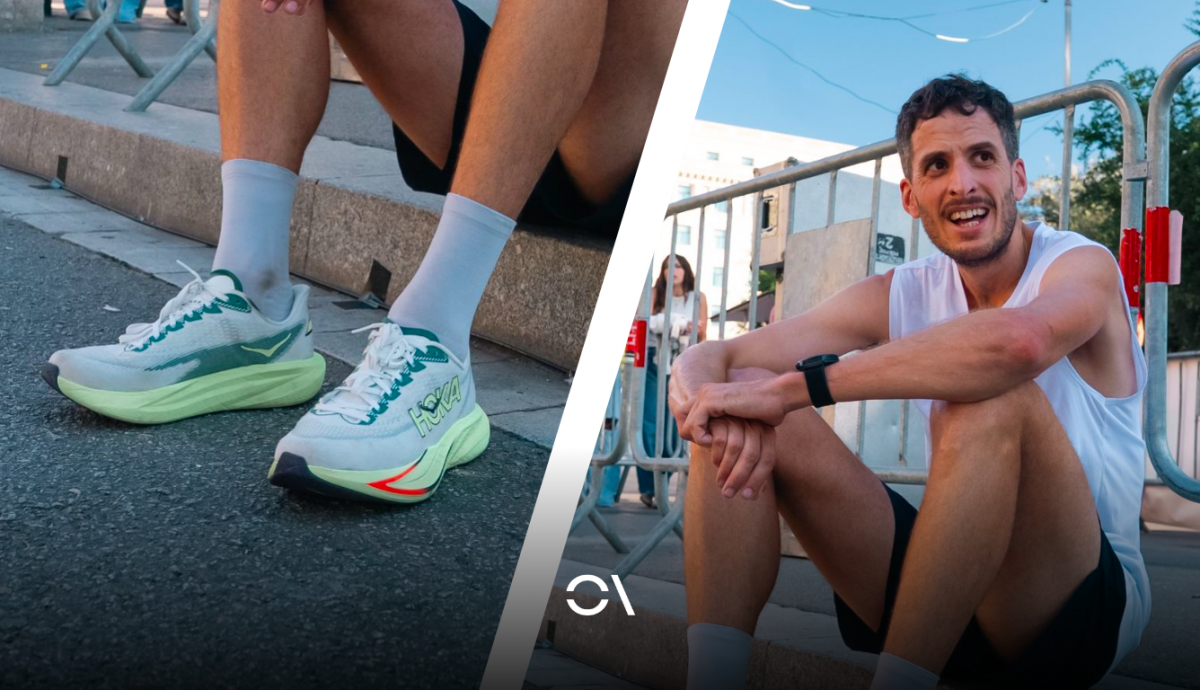
My last time without carbon was eight years ago
The last time I competed without a carbon plate was at the 2018 Behobia San Sebastián. I did it wearing Adidas Adizero Boston on my feet and I remember chatting with my teammate Javi Moro after finishing the race that perhaps it was the last time we would compete without “the new thing.” That race was sponsored by Adidas, but both of us already had the first Nike Vaporfly 4%, which I first used in competition in a 10K in Aranjuez, where I managed to drop below 32 minutes for the first time in my life. Coincidence? I don’t think so.
Since then, dozens of 10K races, half-marathons, and marathons, all with state-of-the-art shoes on my feet. Up to the Mercè Run 2026.
What does it feel like?
The big difference, in my view, lies in the descents. The first miles you hardly notice it, but fatigue shows up afterward. You feel fast, but the clock shows a time that doesn’t align with the sensations you usually associate with it.
I clocked 32:30 and I think I could have been around 32:00 or even lower. It’s true, though, that the race took place very early in the morning, and waking up 50 minutes before the start, with no breakfast, didn’t help.But there was one aspect that caught my attention particularly: the shoe doesn’t let you hide your mistakes as easily when you’re fatigued. On a descent, for instance, with a carbon-plate shoe and a highly reactive foam, I feel I can let myself drop a bit more, keep the pace, and let the shoe do part of the work.
The difference is that you don’t have that sense that there’s something under your foot helping you keep going when your legs start accumulating kilometers.
With the Mach 7 I had to stay more aware of how I struck the ground and to maintain speed by my own means. It doesn’t mean they’re slow shoes, not at all. In fact, I think they’re a fantastic option for running fast. The difference is that you don’t have that sense that there’s something under your foot helping you move forward when your legs begin to accumulate miles.
And that, in a 10K, can be managed. In a marathon, where there are still 15 or 18 kilometers to go when fatigue shows up, it could be a different story.Would I do it again? Will I end up running a marathon?
Yes, I would do it again, although the decision in a marathon would be tough. In a 10K or a half, I feel it matters less, but in a marathon you have to train a lot. It implies a very thorough training regime just to “sacrifice” the time.
If after months of preparing a marathon I reach the starting line in a condition to run at the limit of my possibilities, do I really want to renounce a technological aid that I have been using for the last eight years? Probably not.
I’m looking to better understand which portion of performance comes from the legs and which from the tool you wear on your feet.
But I also think it’s worth trying. Not so much to prove that you can run fast without a carbon plate, but to better understand what portion of performance comes from the legs and what portion from the tool on your feet.
For now, the experiment stays at a 10K and a 32:30. The real test, if it ever comes, will be the marathon. And there it will indeed be interesting to compare the sensations, the rhythm, and, above all, how the body responds when the kilometers appear in which a modern shoe starts to make a difference.

Dylan Holloway