
I remember clearly those years when you would arrive at a track and find only a handful of athletes training. Today, by contrast, it’s common to see groups of runners, recreational runners, young people, veterans, and people stepping into the sport for the first time. And I couldn’t be happier. I love seeing the tracks come alive, discovering so many people enjoying athletics and seeing how a space we previously used relatively few people occupies has become a gathering place for runners of all ages.
For those of us who have been tied to athletics for many years, that image would have seemed like a dream a long time ago. And precisely because I’d like it to keep being that way, I think it’s worth talking about something as simple as it is important: learning to use a track correctly.
Why should we respect Lane 1?
On a running track, typically, the inner lanes are reserved for interval workouts and faster paces, while easy runs, warm-ups, and recoveries are done on the outer lanes or in designated areas. Each facility has its own rules, and it’s important to know them.
Lane 1 deserves special attention for several reasons. The most important of all is safety. When an athlete is performing a fast set, encountering other runners cruising at a slower pace can force them to abruptly change direction, slow down, or overtake in a busy lane. These are situations that can lead to clashes or falls, and they can be avoided with good organization.
We must also pay attention to how we move inside the track. Before crossing a lane or merging into it, it’s wise to look and ensure no runner is approaching. And when finishing a set, we should move out of the path of those who continue running before stopping or recovering. These are simple gestures that prevent dangerous situations, especially when athletes with very different speeds share the space.
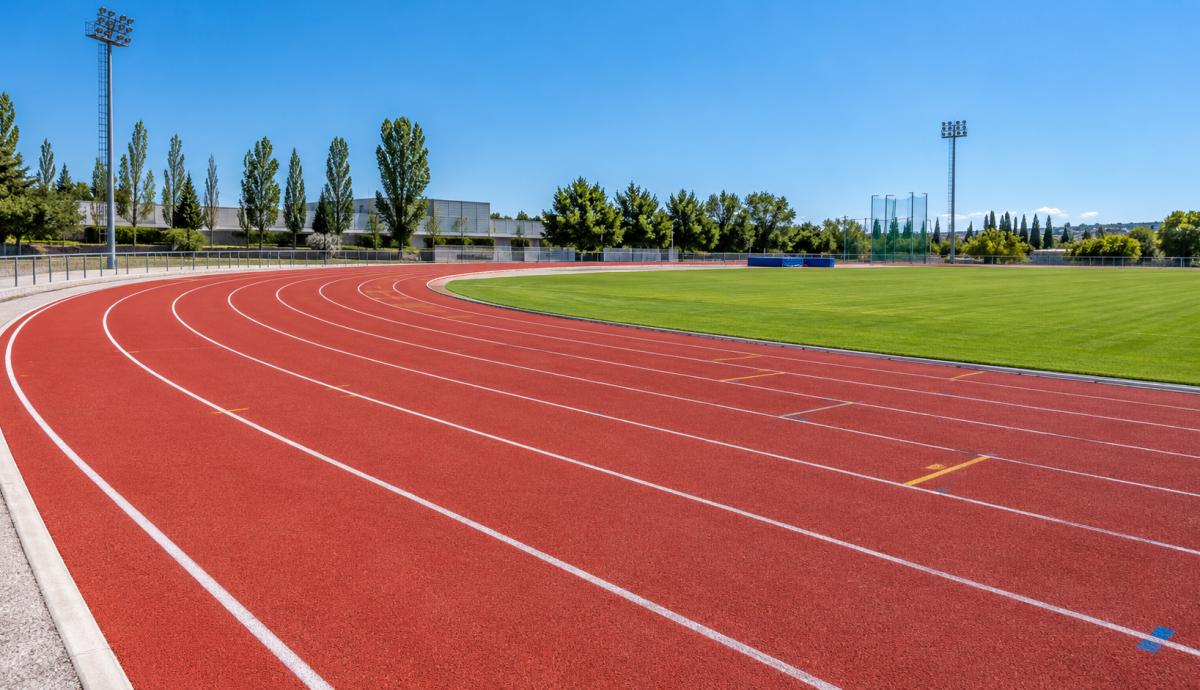
And another reason that perhaps isn’t talked about as much: care of the tartan. Lane 1 is one of the areas that accumulates the most wear precisely because it concentrates a large portion of the training. If we also use it for cruising, warm-ups, or recoveries when other zones are available, we’re adding unnecessary wear to a surface that requires maintenance and whose repair entails a significant cost.
Many tracks feature an outer ring of artificial turf, located after Lane 6 or Lane 8, which is ideal for easy runs, warm-ups, recoveries between intervals, and calming laps, provided it is permitted for that use. It’s a convenient alternative that helps free up the inner lanes.
It’s not only about knowing where not to run; it’s about learning to make proper use of every space a track offers.
Maintaining the tartan is everyone’s responsibility
The maintenance of a running track requires a substantial investment, and its upkeep also depends on how we use it day by day.
Besides distributing trainings properly among the different lanes, we must pay attention to small details: don’t drag fences or other items along the pavement, wear the approved footwear, don’t leave bottles or trash, and respect the directions of the staff in charge of the facility. These are simple habits that help preserve the tartan and the equipment in good condition.
Although it may sound unbelievable, there is another situation I’ve personally encountered: dogs inside the running track, both on a leash and unleashed. A track is not a space for walking pets, much less letting them run freely. A dog’s presence can cause a fall if it unexpectedly crosses the path of someone training at high speed, and its claws can also contribute to surface deterioration. Even a leash can become a dangerous obstacle when someone is sprinting. Therefore, unless access is expressly authorized by the facility, dogs must stay outside the sports enclosure, regardless of whether they are leashed or not.
And the tartan is not asphalt; it is a synthetic surface made, depending on the track type, of materials such as rubber and polyurethane, which give it elasticity, cushioning, and grip. It is precisely this composition that makes running on a track feel a bounce and response under our feet, since the material deforms slightly with each step and then returns to its shape. But that elasticity also reminds us that we are not walking on an indestructible surface. Continuous friction and the concentration of footsteps in certain zones can accelerate its wear, causing a loss of texture and even the detachment of small fragments of material.
Coaches have a lot to teach
I want to linger here because I find it especially important. I am a strong advocate of running groups and the work their coaches do; they have brought athletics closer to many people, created communities, and helped runners who might never have stepped onto a track discover another way to train. And I adore that.
But someone arriving for the first time to a track does not have to know its rules. They do not have to know which lane to use for warming up, where to do recoveries, how to join a set, or why it isn’t wise to stop in the middle of a lane.
That is also what coaches are for. To teach running, of course, but also to convey those small norms of conduct that are part of athletics.
A few minutes at the start of a session to explain where to run, which lanes must be kept clear, how to cross the track safely, or why we should look before merging into a lane. These are simple details that make a big difference when many athletes are training together.
And it isn’t a matter of level. A recreational runner has the same right to enjoy a facility as an experienced athlete, always within their use limits.
A full track is good news
Hopefully we’ll continue to see tracks crowded. Hopefully more children discover athletics, more adults feel encouraged to start running, and more groups share training sessions. I think this is one of the best things that can happen to our sport.
But for that to work, we need something that goes far beyond running: respect for others, for the spaces, and for the facilities that we must preserve together.
You don’t need to know all the rules of athletics to enjoy a track. It’s enough to learn a few basic rules, ask when we have questions, and understand that each lane has a function.
Because taking care of Lane 1, respecting others’ trainings, and protecting the tartan does not mean setting limits for those who arrive; it means making space so that more and more people can join. And that, for those of us who remember tracks that were almost empty, is wonderful news.
