
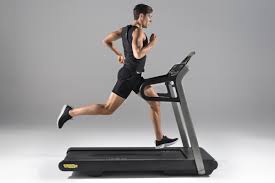
The arrival of the cold, the rain, and the shorter daylight hours lead many runners to move part of their training onto the treadmill. Although the sport remains essentially the same, there are differences between running on a moving surface and running outdoors that can alter the physiological and biomechanical demands of the workout. Knowing these differences will allow you to correctly adjust speed, incline, and session duration to maintain the quality of your winter preparation.
Is running on a treadmill easier than running on the street?
One of the main differences between the two modalities is air resistance. When you run outdoors, your body must move through the air, which entails an additional energy cost that increases with speed. On the treadmill, this resistance is reduced significantly. However, much of the natural ventilation you experience when running outside also disappears. This can make heat dissipation more challenging, especially in gyms with high temperatures and poor air circulation. Consequently, heart rate can rise progressively even when you maintain a constant speed. Other factors also influence the equation, such as the surface characteristics, the treadmill’s cushioning, its calibration, and the runner’s familiarity with this type of training. Therefore, the equivalence between treadmill running and outdoor running depends on multiple variables.
Is it necessary to always set a 1% incline?
One of the most widely circulated pieces of advice among runners is to set an incline of 1% to compensate for the lower air resistance. This recommendation originates from a 1996 study published in the Journal of Sports Sciences, in which Andrew Jones and Jonathan Doust examined the energetic equivalence between treadmill running and outdoor running at different speeds. The work found that a 1% incline could approximate the energy cost of both modalities under the conditions analyzed. However, applying this recommendation automatically to every workout can be unnecessary. The influence of aerodynamic resistance increases with speed, and the conditions of each treadmill can also modify the demands of the exercise. For easy runs you can work with inclines ranging from 0 to 1%, adjusting them based on how you feel. In high-speed workouts, a slight incline can be especially interesting.
How to convert running pace into treadmill speed
While runners typically express their paces in minutes per kilometer, treadmills usually display speeds in kilometers per hour. Here are some of the most common equivalences:
| Pace per kilometer | Treadmill speed |
| 6:30 min/km | 9.23 km/h |
| 6:00 min/km | 10 km/h |
| 5:30 min/km | 10.91 km/h |
| 5:00 min/km | 12 km/h |
| 4:45 min/km | 12.63 km/h |
| 4:30 min/km | 13.33 km/h |
| 4:15 min/km | 14.12 km/h |
| 4:00 min/km | 15 km/h |
| 3:45 min/km | 16 km/h |
| 3:30 min/km | 17.14 km/h |
Keep in mind that the speed shown by the machine may differ slightly from the actual speed due to calibration and maintenance factors.
How to tailor easy runs on the treadmill
The treadmill is a particularly useful tool for controlled aerobic training. It allows you to maintain a constant speed and avoids pace fluctuations caused by traffic, wind, or changes in incline. During easy runs, heart rate and perceived exertion should help you determine intensity. If you notice your heart rate is markedly higher than when you run outdoors at the same pace, check the ambient temperature, ventilation, and hydration. Using a fan can help improve thermal comfort during longer sessions.
How to do intervals on the treadmill
Interval workouts can also be effectively performed on the treadmill, especially when it comes to repetitions of medium or long duration. Sessions such as 6 × 1000 meters, 4 × 2000 meters, or blocks of several minutes at threshold pace allow you to exploit the machine’s ability to maintain a steady intensity. For very short intervals you should consider the time-based nature of the treadmill’s acceleration and the subsequent slowdown during recovery. For this reason, working with time-defined intervals may be more practical than doing them purely by distance. Avoid stepping on or off the treadmill while it is at high speeds, and familiarize yourself in advance with the machine’s controls.
Take advantage of incline to build strength
One of the great advantages of the treadmill is the ability to artificially alter the slope. Running uphill increases energy demands and changes the involvement of different muscle groups, especially the hip extensors and the leg musculature. You can incorporate blocks of several minutes with moderate inclines within your runs or carry out dedicated hill sessions, reducing your speed to maintain the intended intensity. Progression should be gradual, especially if you’re not accustomed to running on an incline.
Can you train for a race on the treadmill?
The treadmill can play a significant role in preparing for a 10K, a half marathon, or a marathon, particularly when weather conditions make outdoor training difficult. However, running outdoors allows you to develop the ability to adapt your support to different surfaces, manage pace changes, handle curves, and respond to the actual characteristics of the course. Combining both modalities will let you take advantage of the strengths of each.
