
Sponsored content by the Regional Government of Castilla-La Mancha.
The calendar fills up with 10-kilometer races, half-marathons, and marathons. We pick a bib number, calculate our pace, and search for gaps to train. But preparing for an asphalt race also raises other questions: does the goal fit our experience? How do we distribute the effort? What role do strength, recovery, and nutrition play?
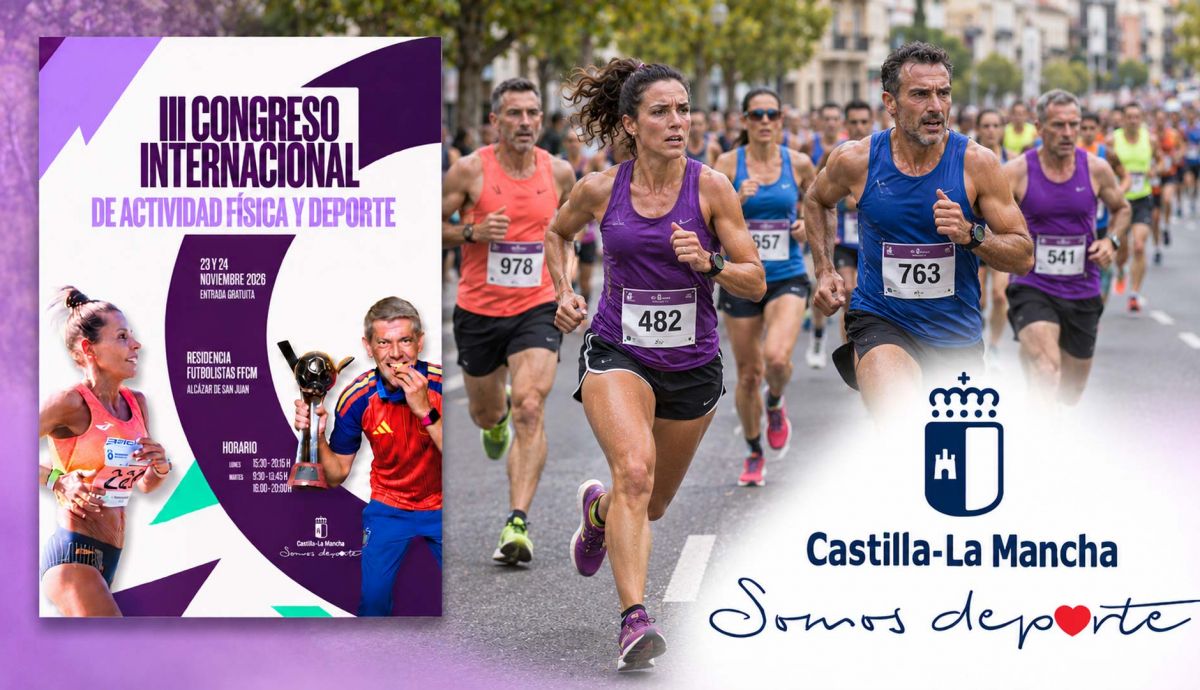
For the recreational runner, improvement means finding answers that can be applied to daily life. With that spirit, the III International Congress on Physical Activity and Sport of Castilla-La Mancha will dedicate the afternoon of Tuesday, November 24 to the challenges of the recreational athlete, with speakers who will focus on preparation and the experience of practicing sport.
Antonio Serrano: the path to the marathon
Antonio Serrano Sánchez will tackle marathon planning, one of the topics that most interests asphalt runners. Whether you’re aiming for your debut or seeking to improve your time, the 42.195 kilometers begin to be prepared long before race day.
The value of planning lies in giving each phase of preparation a function and situating the goal within a real context. The starting point, accumulated experience, and the hours we can dedicate to training shape the path to the target.
For those who run after work or take advantage of the weekend for the long run, listening to a talk on planning is also an opportunity to reassess priorities. Have we chosen a challenge that we can prepare for with the time and consistency we have available?
The talk by Serrano will place the marathon at the center of this segment, with a topic that directly affects the decisions of the recreational runner: how to organize preparation.
Bea Porto: strength is trained beyond the asphalt
Bea Porto Carnicero will address strength in endurance sports. A topic that resonates with a common scene among runners: covering the planned kilometers while the strength work is left for another day.
Her talk draws attention to a part of preparation that deserves its own focus. Research supports that certain strength-training methods can improve running economy, i.e., the energy cost of maintaining a pace. A 2024 review in Sports Medicine (see note) summarizes these benefits, with effects that vary depending on the method and the conditions studied.
*1. Effect of Strength Training Programs in Middle- and Long-Distance Runners’ Economy at Different Running Speeds: A Systematic Review with Meta-analysis. pubmed.ncbi.nlm.nih.gov
For recreational runners, the interest lies in integrating that work coherently with the runs and the demanding sessions. The selection of exercises, the loads, and their distribution throughout the week require adaptation to each runner’s level and experience.
Thus, strength has a place in the conversation about preparing endurance tests, alongside the sessions we perform in running shoes.
Injury prevention: safeguarding continuity
The interest in planning and strength connects with another concern for any runner: the ability to maintain training continuity. No plan guarantees injury-free running, but managing load and recovery is part of caring for the athlete.
The International Olympic Committee’s consensus on load and injury risk notes that injuries have multiple causes and that improper management of training and competition demands can increase risk. (*2). It also considers psychological loads and circumstances outside of the training itself.
*2. How much is too much? (Part 1) International Olympic Committee consensus statement on load in sport and risk of injury. bjsm.bmj.com
Translated to the life of a recreational runner, this approach invites evaluating the entire week: kilometers, hard sessions, rest, and work pressures. Preparation needs room to adapt to the person who is performing it.
That is why it is useful to approach training knowledge with your own questions. How we process weekly loads or what effort we can sustain are issues as important as the pace shown on the clock.
Nutrition: preparing for a race also goes through the table
Alongside training and recovery, nutrition completes the care of the asphalt runner. Needs change according to effort: a short outing and a long run impose different demands.
The International Olympic Committee recommends tailoring the nutritional strategy to training and competition (*3), and highlights the usefulness of professional guidance to adjust energy, nutrient, and fluid needs. It also reminds that fueling during long events should be practiced in training.
*3. IOC Consensus Statement on Sports Nutrition. stillmed.olympics.com
For those preparing a half marathon or a marathon, this opens another task within the process: understanding how you respond to eating and drinking while running, and arriving at the competition with a practiced strategy.
This perspective helps to understand preparation as a whole. The mileage plan, what we eat, and recovery time are interconnected in the day-to-day life of someone aiming to reach their next race in good shape.
Gemma Arenas and Agustín Luján: experience behind the effort
The segment will also feature Gemma Arenas Alcázar and Agustín Luján Maldonado, participants in the panel Lives in Sport — Excellence and Sacrifice, moderated by David García Sánchez.
Their experiences will add a complementary perspective to the talks on preparation. Behind a result there are decisions, dedication, and a relationship with sport that is built over time.
For recreational runners, listening to these experiences offers a space to reflect on their challenges: how much they can devote to them, what they hope to achieve, and how effort fits into their lives.
The afternoon will also include the intervention of Javier Fernández Alba on preparing for a cycling tour, within this block dedicated to those who balance endurance sports with daily responsibilities.
When it takes place and how to register
The Congress, organized by the Dirección General de Deportes de la Junta de Comunidades de Castilla-La Mancha, will be held on 23 and 24 November 2026 at the Residence for Athletes of the Castilla-La Mancha Football Federation, on Pablo Iglesias Avenue, s/n, in Alcázar de San Juan (Ciudad Real). deportes.castillalamancha.es
The block on challenges for the recreational athlete will take place on the afternoon of Tuesday the 24th. The program also includes content on leadership and team management and Physical Education in the educational field.
Check the Congress information and access registration for those who are not currently teaching in Castilla-La Mancha.
Active teachers in the region have a dedicated registration track.
