
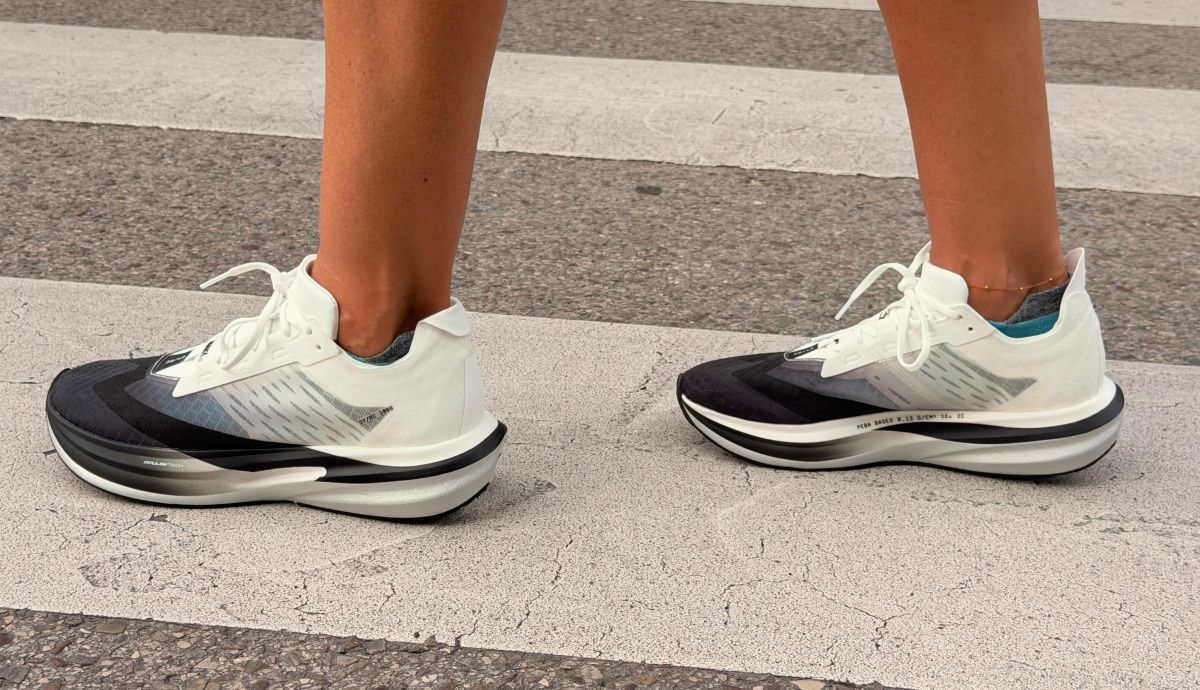
Oysho continues advancing in the world of running and does so with its most ambitious offering to date: the OY/RC1000, shoes developed specifically for competition, with particular emphasis on 10-kilometer races. A model that incorporates technologies usually associated with high-performance footwear and hits the market at a price of 129 euros.
I’ve had the opportunity to test them almost straight from the factory, across several training sessions that included runs finishing at faster paces and activation strides. The initial impressions have been positive, especially in those moments when we leave behind the comfortable pace and begin to demand more from the shoes.
But before talking about how they perform, it’s worth understanding what lies behind their development:
The OY/RC1000 are the result of two years of research and development conducted in collaboration with centers specialized in footwear and biomechanics. During that period, the brand worked with eleven prototype versions, incorporating the assessments of athletes from its team until reaching the final design. Among the competitors who participated in the process was Ángela Viciosa, who raced with a preliminary version of the model in the 10K at the Champs-Élysées in Paris, where she won and set a new personal best.
It’s interesting that the brand has used competition as part of the development because it allows evaluating aspects that aren’t always reproducible in a laboratory, such as fit, stability, or how the whole behaves when speed increases.
One of the most important elements of these shoes lies in their midsole, which debuts the Impulsetech technology, developed by Oysho with the guidance of the University of Massachusetts Amherst.
It is a foam based on PEBA (Polyether Block Amide), a material used in numerous racing shoes for its ability to combine lightness, cushioning, and elastic rebound. In this instance, the foam is manufactured through a supercritical expansion process using nitrogen, which yields a lightweight and resilient cellular structure.
According to the data provided by the brand, Impulsetech offers more than a 15% increase in energy return compared to its Absofoam technology, in addition to a 2% improvement in running economy. The brand also notes that it is 37% lighter than a traditional foam.
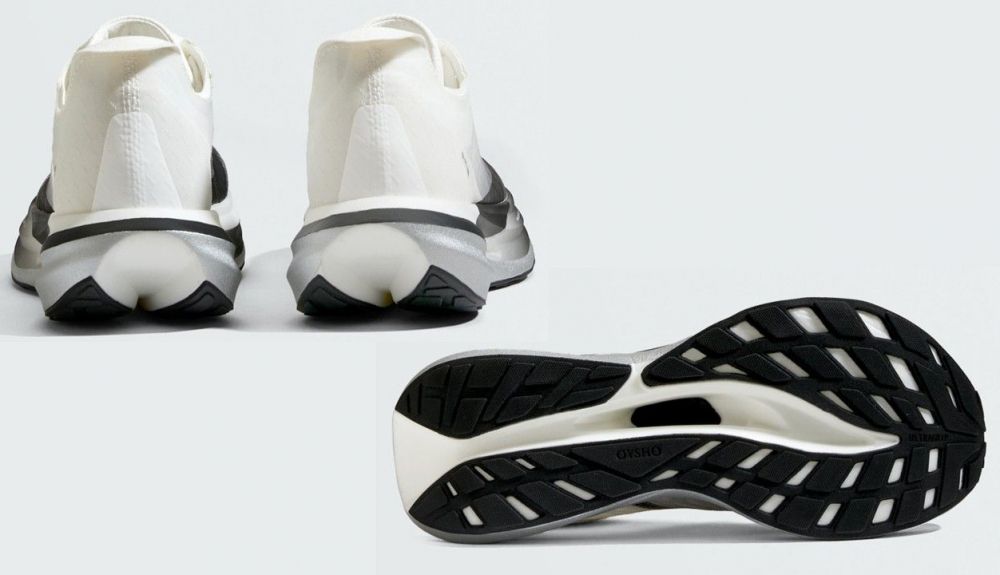
The other major protagonist is its dual-material carbon and nylon plate, integrated into the midsole and accompanied by a pronounced rocker geometry. The aim of this construction is to foster a rapid transition from stance to take-off and to provide a dynamic response as we increase speed.
The choice of a mixed plate is interesting. The behavior of a plate-equipped shoe doesn’t depend solely on its material, but also on its stiffness, its position within the midsole, the foam surrounding it, and the geometry of the whole setup. In the OY/RC1000, all these elements are designed to work in a coordinated fashion, aiming for an agile stride and a response suitable for racing paces.
With a weight of 192 grams in size 37, the OY/RC1000 offers a lightweight construction, something particularly relevant in a model designed for distances like the 10K.
The upper uses an ultrabreathable engineered mesh, designed to fit the foot, provide support, and facilitate ventilation during effort.
The shoe is completed with a CPU sole (Cast Polyurethane), a material chosen by the brand to offer grip and traction on asphalt.
Our First Running Impressions
I have used the OY/RC1000 in several sessions, mainly in runs that finished at brisker paces and in fast activation straightaways. It’s a training style that allows you to start getting to know the character of a racing shoe, especially when moving from a comfortable run to one where we seek higher speeds.
The initial sensations have been positive. Oysho’s proposition seems interesting during those pace changes and has left me eager to accumulate more kilometers to better understand its behavior.
Who is It Designed For?
From a technical standpoint, it could be of interest to runners looking for a dedicated shoe for quality training and competitions, although suitability will depend on pace, running technique, and personal preferences.
The brand also notes that the model carries World Athletics approval for use in official competitions.
And, the price is undoubtedly one of the most striking selling points of the OY/RC1000. For 129 euros, Oysho offers a racing shoe with PEBA foam, a mixed carbon and nylon plate, rocker geometry, and a construction that they bill as weighing under 200 grams in size 37.
