
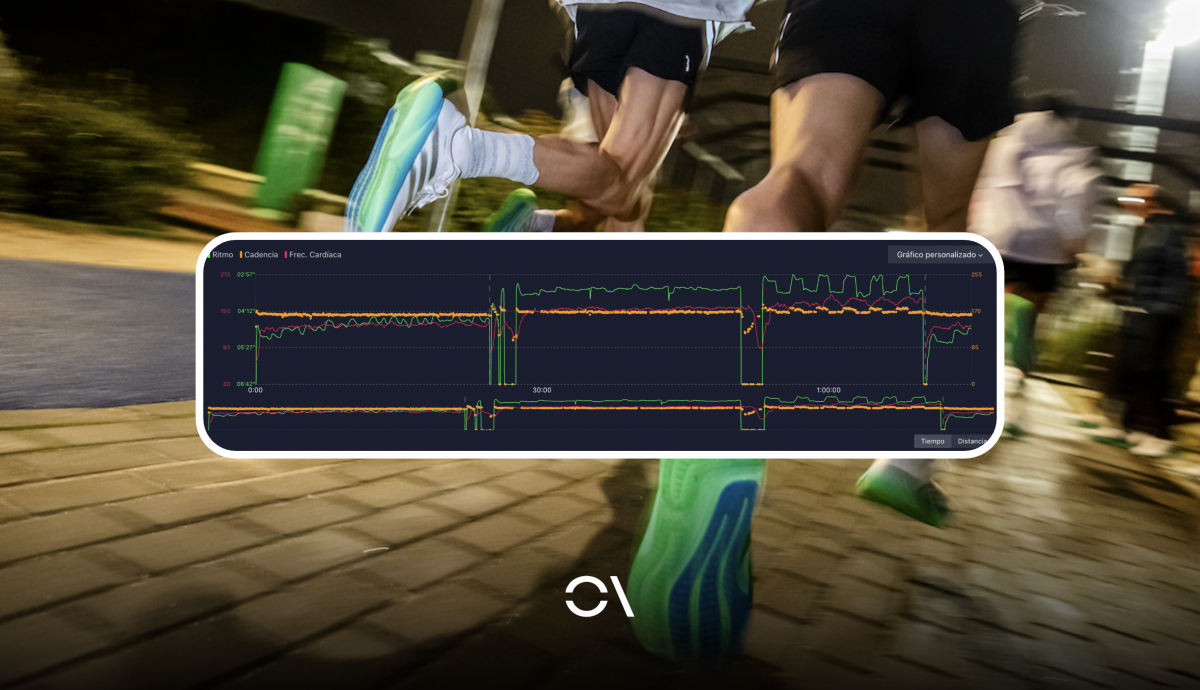
If you’ve been running for a while, you’ve almost surely heard that the ideal cadence is 180 steps per minute. This figure has become so popular that many runners consult their sports watch to check whether they reach this supposed magical number.
The running cadence is the total number of steps we take in one minute, counting both feet. If we take 90 steps with each foot, our cadence will be 180 steps per minute.
This reference comes from observations carried out with elite runners, but that many reach that frequency does not mean it is the best for everyone. Speed, height, leg length, and experience also influence. Therefore, we can find very different cadences among runners.
You don’t need to reach 180 steps per minute to run well. If you run comfortably, you make progress and you don’t experience recurring discomfort, a lower cadence isn’t necessarily a problem.
Cadence and pace: how are they related?
The running speed depends on two factors: step frequency and the distance covered with each stride.
If you increase the frequency while keeping the stride length, you’ll run faster. But if you take shorter steps, your speed may stay the same. That’s why two runners can maintain the same pace with different cadences.
Running faster and running more efficiently are not the same thing. Increasing cadence can help some runners improve their mechanics, but it doesn’t always provide an advantage.
Does increasing cadence improve technique and prevent injuries?
Slightly raising the frequency tends to shorten the stride and can cause the foot to strike the ground closer to the body. This can modify the loads borne by certain joints.
However, reducing load in one area does not mean reducing it in the whole body. A higher cadence may lessen certain demands on the knee but increase the work of the calves or the demands on the ankle and foot.
Nor is it proven that increasing steps per minute reliably lowers the risk of injury for all runners. Injuries depend on multiple factors, such as training load, recovery, muscular strength, and injury history.
If you suffer from recurring discomfort, changing cadence could help you manage certain loads, but it’s wise to first identify the problem and assess whether that change makes sense.
How to adapt cadence on climbs and descents?
On climbs, the stride tends to shorten and the pace slows. Slightly increasing the frequency can help keep a smooth motion, but there is no universal optimal cadence for all slopes. What matters is controlling your steps and maintaining a sustainable effort.
On descents, an excessively long stride can increase braking forces. In certain situations, taking slightly shorter and more frequent steps helps control the descent. On technical terrain, the priority should be maintaining balance and choosing secure foot placements.
It’s not about taking the maximum number of steps possible, but about adapting to the terrain without losing control.
How to find your ideal cadence
To know your usual frequency, measure the steps you take in one minute at your normal pace, preferably on flat ground and after a few minutes of running. You can also check this data on your sports watch.
Repeat the measurement across several workouts and at different paces: you’ll find that cadence changes when you speed up, tire, or change terrain.
If you want to try a slightly higher frequency, introduce the change gradually and in short intervals. Assess whether you run comfortably, maintain the pace with a similar effort, and do not experience discomfort in the calves, ankles, or feet.
The best cadence is not necessarily the one that hits 180, but the one that allows you to run efficiently and adapt to the effort. Rather than chasing a magical number, listen to your sensations and use the watch data as a reference, not as a requirement.
