
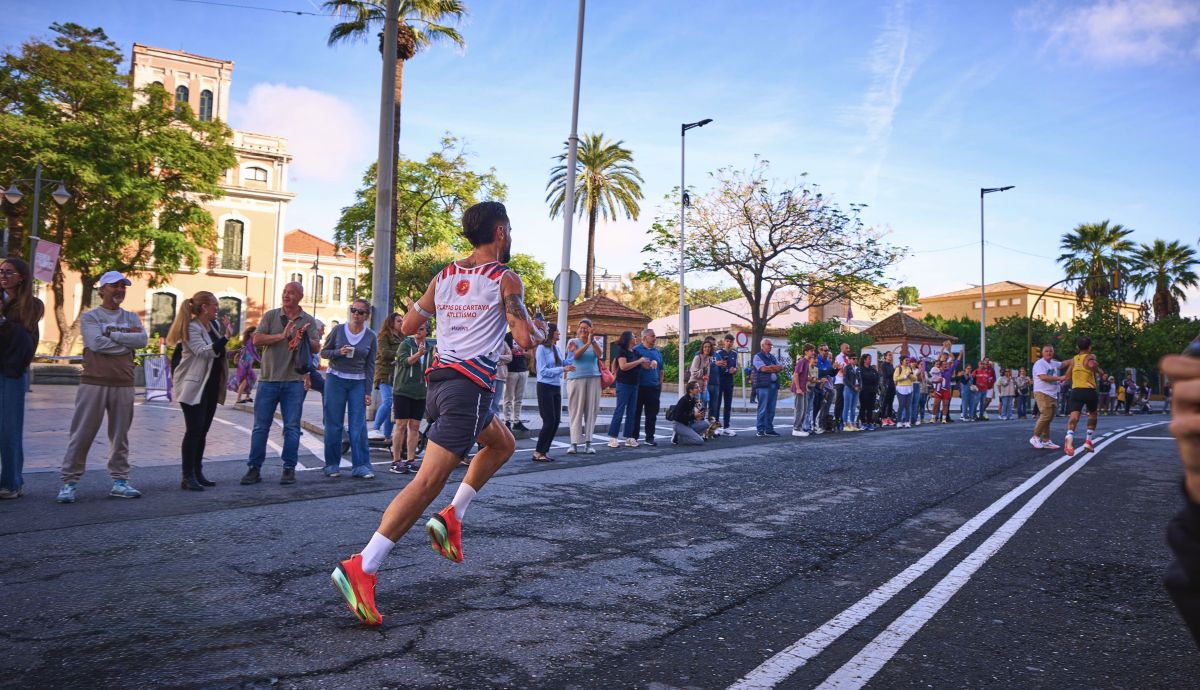
The 21K Ciudad de Huelva (November 1 at 10:00) embraces an urban route that blends speed, variety, and strategy. Starting at the Plaza de la Constitución, beside the Town Hall, the course crosses some of the capital of Huelva’s main avenues and neighborhoods. Although Huelva’s terrain, shaped by its headlands, introduces climbs in the central part, the first nine kilometers are almost flat and the last four feature a favorable profile, offering good conditions for those aiming to improve their half-marathon time.
Nine Initial Kilometers to Find Your Rhythm
The race begins in the heart of Huelva and heads toward Italy Avenue and Germany Avenue. During these first three kilometers, competitors traverse two of the city’s major arteries and pass by notable spots such as the bullring (Plaza de Toros). The route continues along the Paseo de las Palmeras and Avenida Doctor Rubio before entering Pescadería, one of Huelva’s newer expansion zones. From there, it reconnects with Italy Avenue and Avenida Guatemala. This initial sector is one of the circuit’s main attractions: the first nine kilometers are practically flat, with wide avenues that facilitate maintaining a steady pace. It’s a stretch conducive to feeling good, though it’s wise to adjust speed to the planned goal and keep in mind the demands of the kilometers to come.
The Climbs Concentrate the Effort in the Central Section
Around kilometer nine, a climb of about one kilometer appears. According to the organizers’ description, it does not present an especially steep incline, but its persistence obliges athletes to manage their effort to arrive at the second half with reserves. Afterward, the course leads toward Avenida Andalucía, which runners use in both directions. Between kilometers ten and fifteen, the race winds through different parts of the city until reaching the neighborhoods of Huerto Paco and La Orden. In this stretch, there is another segment of roughly two or three kilometers that gains height progressively. The central part therefore concentrates the main difficulty of the route and requires adjusting the pace to the climbs, preventing the early attempt to sustain the initial speed from compromising the finish.
Four Final Kilometers to Accelerate
After passing the main entrance of Parque Moret, the profile changes. The last four kilometers offer a long, favorable stretch where participants can progressively increase speed if they have managed their energy well. The circuit thus presents three distinct phases: a flat start to stabilize the pace, a central section where pace control becomes crucial, and a finish that allows a renewed surge. The potential of the route to deliver strong times is undeniable; the event record stands at 1:03:05 and five athletes finished under 1:07:00. Beyond the stopwatch, moving through different neighborhoods and avenues adds variety to the experience and provides the public with multiple spots to cheer. The 21K Ciudad de Huelva offers an urban half marathon where understanding the profile can make a difference: taking advantage of the fast stretches, managing the climbs, and saving energy for a favorable finish.
